Geomembranes are impermeable polymer liners widely used for environmental containment. The two most popular polyethylene types are HDPE and LLDPE geomembrane. Many project owners, engineers and contractors struggle to pick the right material. Each material has a unique molecular structure, mechanical performance and suitable working conditions. Choosing the wrong liner can lead to cracking, leakage, expensive repairs and long-term environmental risks.
BPM Geomembrane manufactures both HDPE and LLDPE geomembrane to GRI and ASTM standards. Understanding their core differences helps you make cost-effective, long-lasting liner selections for landfills, mining ponds, aquaculture lagoons, reservoirs and secondary containment projects.
1. Basic Molecular and Physical Structure
HDPE stands for High-Density Polyethylene. It has a tightly packed, linear molecular arrangement with low branching. Its density is 0.940–0.965 g/cm³. This dense structure gives HDPE high stiffness and outstanding chemical stability.
LLDPE means Linear Low-Density Polyethylene. It has short side branches on its linear polymer chain. Its density ranges from 0.915 to 0.925 g/cm³. The looser molecular structure makes LLDPE softer and much more flexible than HDPE. This is the root cause of most performance differences between these two geomembranes.
2. Key Performance Differences
2.1 Flexibility and Elongation
LLDPE geomembrane delivers excellent flexibility and ultra-high elongation at break, normally 800% to 1200%. It can stretch significantly under uneven settlement or local ground deformation without tearing. It conforms well to irregular subgrades, rough terrain, pipe penetrations and curved corners. In cold climates, LLDPE keeps ductility even at −40°C, so it resists brittle cracking during freeze-thaw cycles.
HDPE is stiffer with elongation at break around 700%. It cannot bend easily. If the base soil settles sharply or has sharp local deformation, standard HDPE may crack. HDPE performs better in warm and stable subgrade conditions. BPM produces textured HDPE grades to improve slope friction, but HDPE still cannot match LLDPE’s conformability.
2.2 Chemical Resistance
HDPE geomembrane has superior chemical resistance. It resists most acids, alkalis, heavy metals and many organic solvents. It works stably under pH 2–12 environments. This is why HDPE is the primary choice for municipal landfill base liners, mining heap leach pads and industrial waste containment. Its long-term service life under harsh leachate can reach 50–100 years.
LLDPE has good resistance to salts, weak acids and fertilizers. However, it swells and degrades when exposed to strong organic solvents and high-concentration hydrocarbon waste. It is not recommended as the primary liner for hazardous waste landfills. LLDPE is suitable for aquaculture, irrigation canals, reservoir liners and landfill final cover systems where chemical exposure is mild.
2.3 Mechanical Strength: Tear and Puncture Resistance
LLDPE has excellent puncture and tear resistance. Its ductile structure absorbs impact from gravel, rock fragments and sharp soil particles. When the subbase has minor sharp points, LLDPE can deform locally without forming pinholes.
HDPE has high tensile yield strength and high modulus. It maintains shape under sustained loading. But HDPE is more sensitive to concentrated sharp impacts. Once the stress exceeds its limit, it tends to crack rapidly. For HDPE liner projects, protective nonwoven geotextile cushion layers are strongly required to prevent puncture damage.
2.4 Installation and Welding
LLDPE’s flexibility simplifies field installation. It lays flatter on uneven ground and creates fewer wrinkles. Welding around pipes, anchor trenches and complex geometric details is easier. However, LLDPE requires careful adjustment of welding temperature and speed. Improper heat fusion may cause weak seams.
HDPE needs stricter surface preparation. The subgrade must be smooth and compacted. HDPE panels are rigid and more prone to creases. Certified welding crews are essential. BPM supplies wide-width HDPE rolls up to 10 meters, reducing total weld seams and lowering leakage risk for large containment cells.
2.5 Service Life and UV Resistance
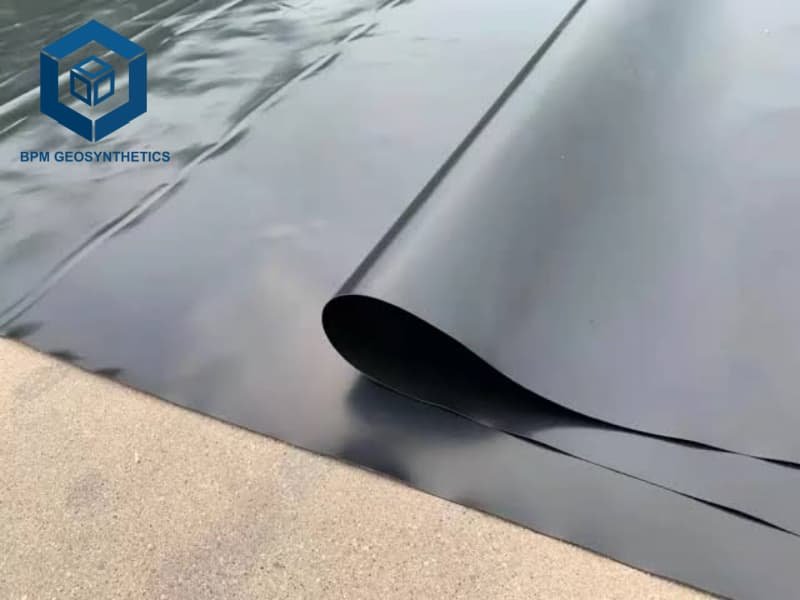
Both HDPE and LLDPE geomembrane from BPM contain carbon black additives for UV stabilization. When buried under soil or waste, HDPE has a longer design life. Exposed LLDPE liners can work for decades, but continuous direct UV exposure will slowly reduce performance over time. For exposed liner surfaces, protective cover or a thicker material specification is recommended.
2.6 Cost
For the same thickness, LLDPE geomembrane is normally 10–25% cheaper than HDPE. But material price should not be the only decision factor. In high-risk waste containment, the long-term failure cost of a low-cost LLDPE can be far higher than the initial material savings.
3. Comparison Table: LLDPE vs HDPE Geomembrane
Property | HDPE Geomembrane | LLDPE Geomembrane |
Density | 0.940–0.965 g/cm³ | 0.915–0.925 g/cm³ |
Elongation at Break | ≥700% | 800%–1200% |
Flexibility | Stiff, low conformability | Highly flexible, adapts to uneven ground |
Chemical Resistance | Excellent for acids, alkalis, hydrocarbons | Good for mild chemicals; poor for strong solvents |
Low-temperature performance | Risk of brittle cracking in extreme cold | Excellent ductility down to −40°C |
Puncture Resistance | Good, needs geotextile cushion | Very good, absorbs impact deformation |
Typical Service Life (buried) | 50–100 years | 40–80 years |
Main Applications | Landfill base liner, mining leach pad, industrial containment | Aquaculture ponds, canal liner, reservoir, landfill cover |
Relative Cost | Higher | 10–25% lower than HDPE of equal thickness |
BPM Standard | GRI-GM13 | GRI-GM17 |
4. Typical Project Applications
4.1 When to Use HDPE Geomembrane
HDPE is the preferred liner for high-risk containment.
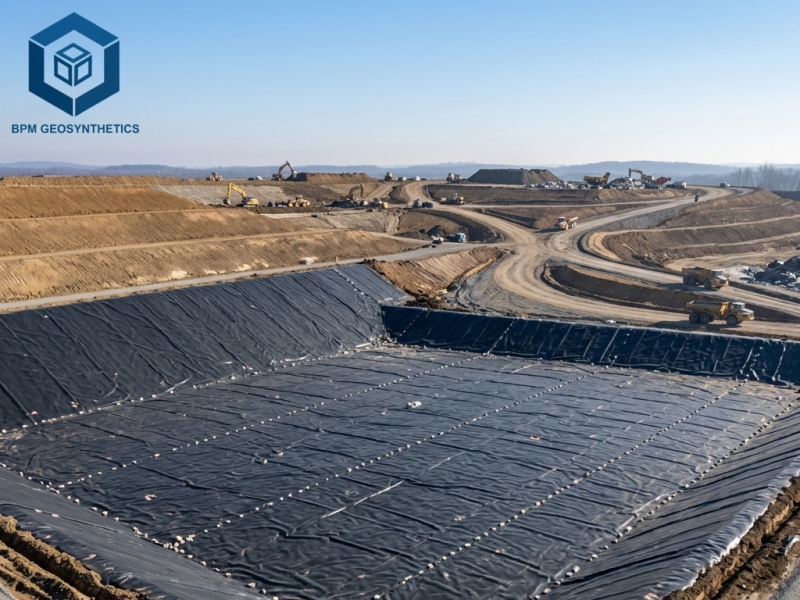
- Municipal solid waste landfill primary liners
- Hazardous waste containment cells
- Mining heap leach pads and tailings ponds
- Industrial wastewater lagoons with complex chemical pollutants
BPM HDPE geomembrane follows GRI-GM13 standard. It passes strict third-party testing on tensile, tear, puncture, carbon black dispersion and oxidative induction time. Both smooth and textured HDPE options are available for flat base and steep slope designs. Wide-width rolls reduce field weld quantity and improve construction quality.
4.2 When to Use LLDPE Geomembrane
LLDPE fits projects with mild chemical exposure and possible ground settlement.
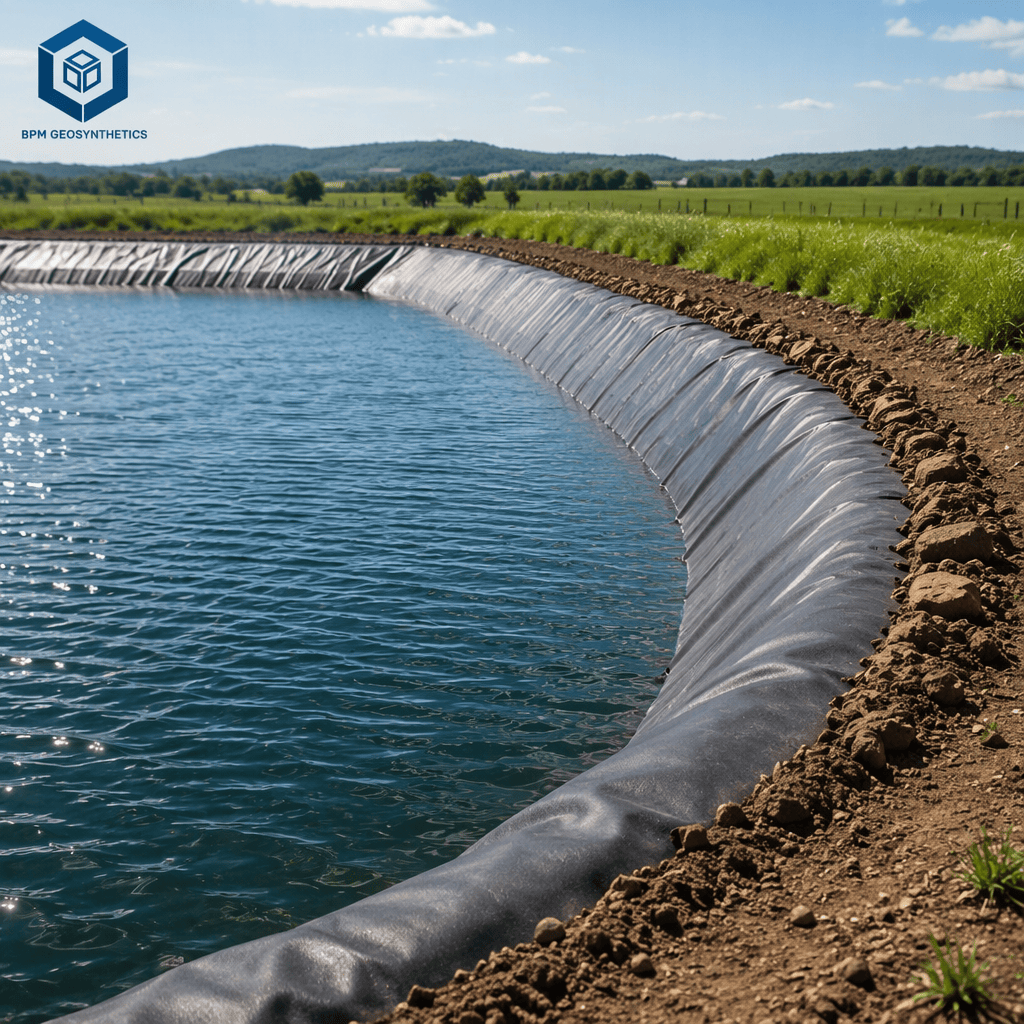
- Fish and shrimp aquaculture ponds
- Irrigation canals and artificial lakes
- Reservoir and stormwater lagoons
- Landfill final cover liner
- Temporary containment projects in cold regions
BPM LLDPE geomembrane meets GRI-GM17 requirements. It works well on sites with variable terrain and freeze-thaw cycles. It is a budget-friendly liner for low-chemical-risk projects.
5. Common Selection Mistakes to Avoid
Some engineers choose LLDPE simply because of lower price, then use it for landfill base liner with strong leachate. This mistake can cause liner swelling and early leakage.
Others select HDPE on sites with unstable subgrade and heavy differential settlement. Without enough cushion protection, HDPE may crack after waste or water loading.
The best practice is to evaluate three factors: chemical environment, ground deformation risk and local climate. Then pick the right material, thickness and supporting geosynthetic layers.
6. Why Choose BPM for HDPE and LLDPE Geomembrane
BPM manufactures both HDPE and LLDPE geomembrane under one roof. The full production line supports custom thickness, smooth or textured surface and different roll widths. Every batch carries complete test certificates. All products comply with ISO 9001, ISO 14001, CE and relevant GRI standards.
BPM’s technical team can assist engineers in material selection. They review project conditions and recommend HDPE or LLDPE, plus matching geotextile and GCL solutions. Short lead time and global shipment support large landfill, mining and water conservancy projects worldwide.
7. Conclusion
The main difference between LLDPE and HDPE geomembrane comes from molecular density and chain structure. HDPE is stiff, chemically resistant and the gold standard for landfill and mining containment. LLDPE is flexible, highly stretchable and better for uneven ground, cold climates and low-chemical pond projects.
There is no universal “better” geomembrane. The correct choice depends on your containment goals, chemical exposure, subgrade stability, temperature and budget. BPM supplies both HDPE and LLDPE geomembrane with full quality testing and professional engineering support to help your liner project achieve long-term safety and value.