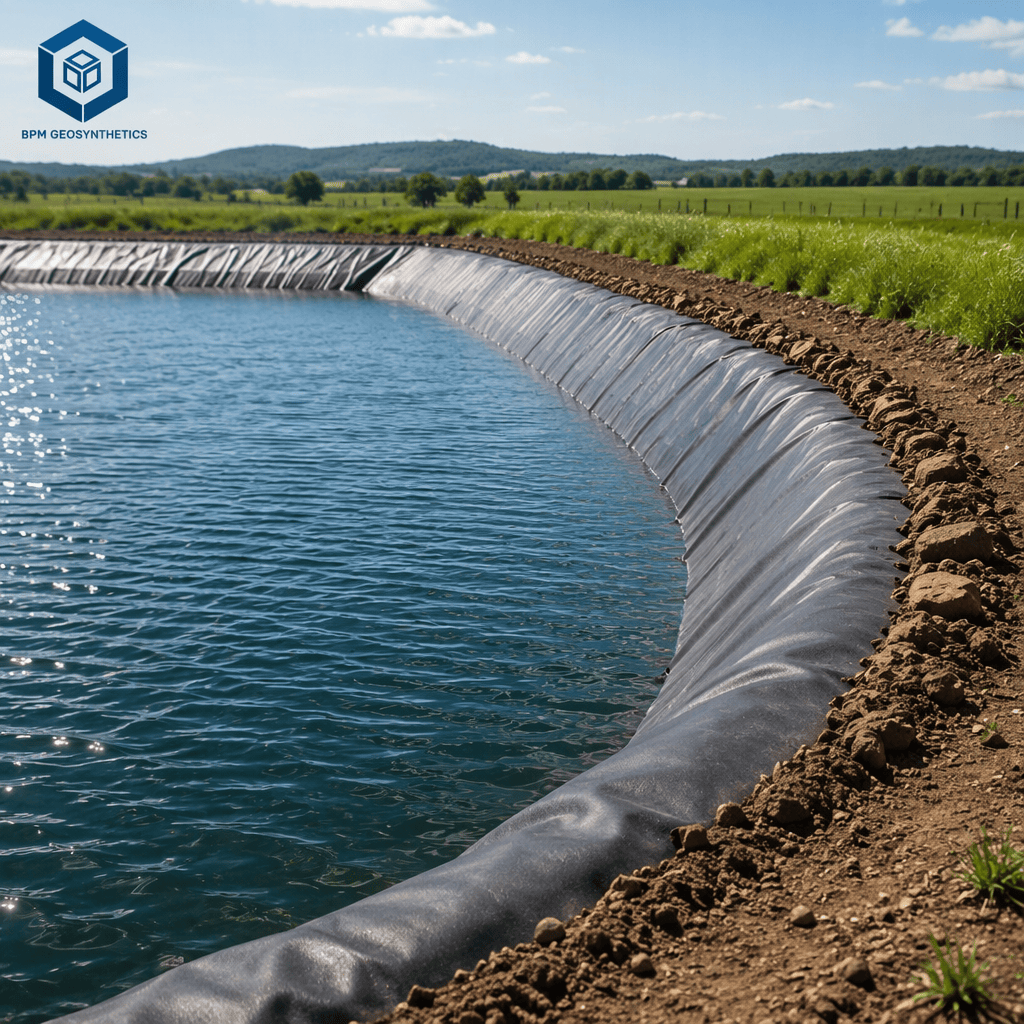
Landfills are essential infrastructure for solid waste disposal. A landfill geomembrane acts as the primary impermeable barrier inside waste containment cells. It stops leachate from migrating into underground aquifers and surrounding soil. Without a properly installed geomembrane system, heavy metals, ammonia nitrogen, volatile organic compounds and other toxic contaminants can leak out. This causes long-term damage to drinking water supplies and local ecosystems.
In the United States, EPA Subtitle D regulations (40 CFR Part 258.40) set mandatory standards for municipal solid waste landfills. All new municipal landfill cells must use a composite liner system. The upper barrier layer is almost always HDPE geomembrane, with a minimum thickness of 60 mil (1.5 mm). Below the geomembrane, there needs to be either compacted clay liner (CCL) with low hydraulic conductivity, or an equivalent geosynthetic clay liner (GCL). Hazardous waste landfills face stricter rules and require double liner systems.
If you are preparing a landfill tender or project budget, you will naturally ask: How much does landfill geomembrane cost? The answer depends on material grade, thickness, installation and the supplier you choose. This guide also explains why BPM Geomembrane offers a strong price-performance balance for landfill projects.
1. Overall Landfill Geomembrane Price Range
Based on 2025–2026 global geosynthetics market data, the total installed cost for a standard single composite landfill liner falls between $8 and $14 per square meter. If the project uses thick compacted clay as the sublayer, the full installed cost can rise to $12–$20 per square meter. For double composite liner systems, widely used for hazardous waste cells, the complete installed price ranges from $12 to $25 per square meter.
When we only count raw geomembrane material, 1.5 mm HDPE landfill geomembrane costs roughly $2.50 to $5.50 per square meter. This material-only price does not cover site preparation, transportation, welding, geotextiles, GCL, quality assurance testing or labour. Take a 10-acre (around 40,000 square meters) landfill cell as an example. The full composite liner system budget will be between $320,000 and $810,000. These extra items can add 30% to 60% to the total project investment.
The single largest lever on this budget is the supplier. According to BPM’s published data, BPM Geomembrane HDPE liners are typically 25–45% lower in material cost per square meter than equivalent North American or European products, while maintaining full GRI-GM13 compliance. This difference directly lowers the upfront budget without weakening containment performance.
2. Main Factors That Change Landfill Geomembrane Costs
2.1 Resin Type, Thickness and Surface Texture
HDPE geomembrane remains the top choice for landfill projects. It offers excellent chemical resistance against landfill leachate, strong UV stability and long service life. A well-managed HDPE liner can last 50 to 100 years under buried landfill conditions.
Thickness directly affects material price and regulatory compliance.
- 0 mm HDPE: $1.80–$3.50 per m². Used for low-risk auxiliary areas.
- 5 mm HDPE: $2.50–$5.00 per m². Standard thickness for most municipal landfill base liners.
- 0 mm HDPE: $3.50–$7.00 per m². Common for hazardous waste landfills.
- 5 mm HDPE: $5.00–$9.00 per m². Reserved for extreme chemical exposure.
Textured HDPE geomembrane has rough surfaces on one or both sides. It increases friction on steep landfill slopes to prevent liner sliding. Textured products add 15% to 30% to material costs compared with smooth HDPE of the same thickness. BPM offers smooth, textured and composite options across a full 0.5–3.0 mm thickness range, so buyers can match the exact specification to the waste risk and terrain.
2.2 Sub-liner Selection: GCL versus Compacted Clay Liner (CCL)
A geomembrane rarely works alone in a modern landfill. It pairs with a secondary low-permeability layer. Geosynthetic clay liner (GCL) material costs $1.00–$2.50 per m² and installs fast. Compacted clay liner (CCL) costs $8–$18 per m² but needs much more earthwork. Over 70% of new municipal landfill cells in North America select GCL to shorten construction time and cut total cost.
2.3 Installation, Welding and CQA
Installation and field work often account for 30% to 50% of the total composite liner budget. Certified welding crews heat-fuse geomembrane panels together. Welding labour costs range from $2.00 to $8.00 per square meter. Steep slopes and complex corners push labour toward the higher end. Third-party Construction Quality Assurance (CQA) is mandatory for regulated projects. It costs $0.50–$2.00 per square meter and reduces long-term leakage risk by more than 90%.
Fewer seams mean lower cost and less risk. This is why wide rolls matter. BPM produces wide-width rolls up to 7–8 m, which reduce field seams by 30–50% and dramatically lower the number of potential leak points.
2.4 Project Scale, Location and Site Conditions
Project size creates clear economies of scale. Small projects below 10,000 m² cost $12–$25 per m² installed. Large projects above 50,000 m² cost $8–$14 per m² installed. Remote sites add 15%–40% to total spending. Steep slopes add 20%–50% to installation cost. Wet ground and rock outcrops also push up budget.
3. Landfill Liner Component Cost Table
Item | Price Range (USD per m²) | Description |
1.5 mm Smooth HDPE Geomembrane | $2.50 – $5.50 | Standard primary liner for municipal landfill |
1.5 mm Textured HDPE Geomembrane | +15% to +30% premium | Anti-slip for steep landfill slopes |
GCL (Geosynthetic Clay Liner) | $1.00 – $2.50 | Secondary low-permeability barrier |
Protective Nonwoven Geotextile | $0.40 – $1.20 | Anti-puncture cushion layer |
Installation & Welding Labour | $2.00 – $8.00 | Panel deployment, fusion welding, seam repairs |
Third-party CQA Service | $0.50 – $2.00 | Material inspection, weld testing, documentation |
Single Composite Liner (Full Installed) | $8.00 – $14.00 | HDPE + GCL + geotextile + labour + basic QA |
Double Composite Liner (Full Installed) | $12.00 – $25.00 | Two geomembranes, leak detection layer, accessories |
4. Why Choose BPM Geomembrane for Your Landfill
BPM Geosynthetics (The Best Project Material Co., Ltd.) is a global supplier of HDPE geomembranes founded in 2010 and headquartered in Taian, China. It holds ISO 9001 and ISO 14001 certifications, with an annual production capacity of more than 80,000 tons. BPM’s published advantages are built around three pillars: full compliance, high performance and strong cost efficiency. Each directly lowers the total cost of a landfill liner system.
Key advantages reported by BPM include:
- Full GRI-GM13 compliance. Third-party verified thickness, tensile, tear, puncture, seam strength and carbon black dispersion meet or exceed all minimum requirements.
- High puncture resistance of 550–1,350 N. This gives excellent protection against waste placement equipment and angular refuse.
- Wide roll widths up to 7–8 m. This reduces field seams by 30–50%, cutting both labour cost and potential leak locations.
- Highly competitive economics. Material cost per square meter is typically 25–45% lower than equivalent North American or European products, while keeping full GRI-GM13 compliance.
- Strong mechanical properties. Tensile strength up to 44 kN/m, puncture resistance up to 960 N, and HP-OIT ≥ 400 minutes.
- A full product line. Smooth, textured and composite HDPE from 0.5 to 3.0 mm, so the liner matches the exact landfill specification.
- Recognized certifications. ISO 9001, ISO 14001, NSF/ANSI 61, CE, plus third-party testing from SGS, BV and other bodies.
- Reliable supply and delivery. Lead times of about 15–30 days and hundreds of millions of square meters installed worldwide.
- Sustainability focus. About 30% recycled HDPE, zero-waste extrusion and a reported 12% emission reduction.
4.1 BPM HDPE Geomembrane Product Snapshot
Parameter | BPM Typical Value | Benefit for Landfill |
Thickness | 0.5 – 3.0 mm | Match waste risk and slope needs |
Tensile Strength | up to 44 kN/m | High resistance to placement loads |
Puncture Resistance | 550 – 1,350 N | Protects against sharp refuse |
Roll Width | up to 7–8 m | Fewer seams, lower leak risk |
Certifications | GRI-GM13, ISO, CE, NSF/ANSI 61 | Regulatory approval and QA |
Relative Material Cost | 25–45% lower than western peers | Direct upfront budget savings |
5. Real Landfill Project Cost Cases (2024–2025)
Case 1: Small municipal landfill expansion cell, 5 acres (approx. 20,000 m²). Design uses single composite liner: 1.5 mm smooth HDPE geomembrane + GCL + protective geotextile. Total installed liner budget is between $148,000 and $253,000. The project has gentle slopes and easy road access, so labour and mobilization fees stay moderate.
Case 2: Regional municipal landfill expansion, 20 acres (approx. 80,000 m²). The site handles high organic waste load, so engineers specify double composite liner system. The total installed liner budget ranges from $970,000 to $1,780,000. This budget covers leak detection layers, extra geotextile and full-time on-site CQA inspectors.
Case 3: Hazardous waste landfill cell, 3 acres (approx. 12,000 m²). It adopts 2.0 mm textured HDPE double liner system. Strict permits require full continuous CQA and extra leak monitoring ports. Total installed liner cost reaches $240,000 to $420,000.
In each case, the geomembrane material is the largest single cost item, at 40–60% of the liner system budget. Because BPM cuts the material line by 25–45% against premium western brands while meeting GRI-GM13, project owners can reduce the overall liner system cost by a meaningful share without sacrificing compliance.
6. Practical Ways to Reduce Landfill Geomembrane Costs
Choose wide-width geomembrane rolls (7 m to 10 m wide). Wider panels cut total seam length by 15% to 40%. Fewer welds lower labour cost and reduce potential leakage points.
Use geocomposite drainage layers instead of crushed stone drainage layers. They save $2–$5 per square meter and reduce excavation volume.
Plan bulk purchasing. Orders over 50,000 square meters usually qualify for 15%–30% discount on geosynthetic materials.
Always buy geomembrane certified to GRI-GM13. Low-grade material may fail quickly. The repair, cleanup and regulatory penalty cost will be far higher than the initial savings.
Work with experienced installers and obtain multiple competitive bids. Compare total installed price, not just the material unit price.
7. Conclusion
Landfill geomembrane cost varies widely based on design requirements, material grade, site terrain, project scale and regulatory standards. For 2025–2026 market conditions, a single composite landfill liner fully installed runs $8–$20 per square meter. Double composite liner systems cost $12–$25 per square meter.
Raw 1.5 mm HDPE geomembrane material accounts for only part of total spending. Installation, third-party quality assurance, geotextile cushions and secondary barriers make up 50%–70% of the total liner budget. Still, the geomembrane is the largest single material item and the place where careful procurement pays off most.
For a landfill owner who wants full GRI-GM13 compliance, high puncture resistance, fewer field seams and strong cost efficiency, BPM Geomembrane offers a compelling option. According to BPM’s published data, its HDPE liners deliver material savings of 25–45% against equivalent western products without compromising performance. By pairing the right thickness, wide rolls and a certified supplier, you can control upfront cost while keeping the landfill leak-free for decades.