If you work in construction, waste management, aquaculture or environmental engineering, you must have searched for HDPE geomembrane price online. Many buyers only focus on the lowest price at first. But cheap geomembranes often bring huge hidden costs: leakage, short service life, project rework and environmental fines.
This article will break down everything that decides HDPE geomembrane price in simple language.
1.Raw Material Quality: Virgin HDPE vs Recycled HDPE
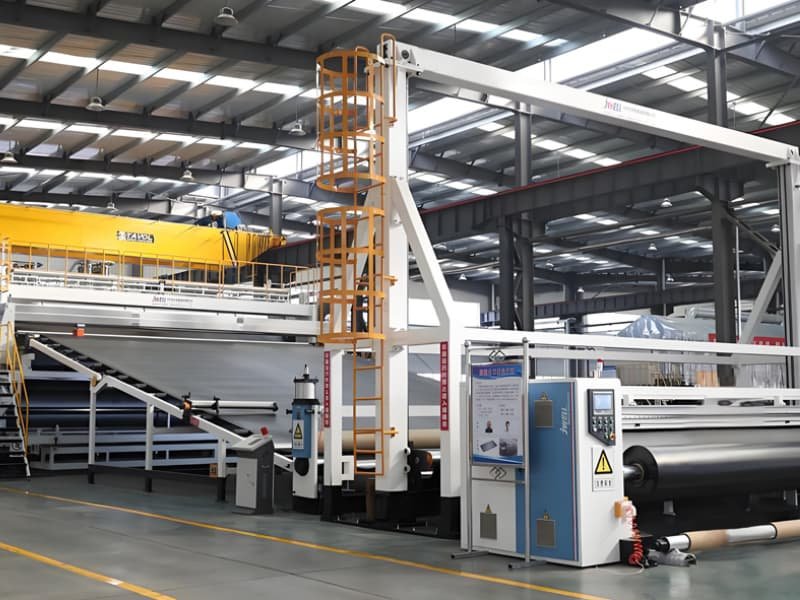
Raw material takes up 70% of geomembrane production cost. Two types of HDPE resin create huge price gaps.
Virgin HDPE resin (BPM full adoption): Directly produced from petroleum. The molecular structure stays stable. It meets all ASTM and GRI GM13 test standards. Tensile, puncture, UV anti-aging data reach strict project requirements. Virgin resin geomembrane can work 30–50 years buried underground. Price is higher, but no rework cost later.
Recycled HDPE resin: Made from waste plastic bottles and plastic bags. Impurities cannot be fully removed. Carbon black dispersion and anti-oxidation capacity drop sharply. Tensile strength and elongation fail international standards. Recycled liners crack under sunlight within 3–8 years.
The raw material cost is 10%–30% lower, yet most landfill, mining and municipal wastewater projects reject recycled products because they cannot pass third-party inspection.
BPM never mixes recycled resin into our GRI GM13 geomembrane. All our batches provide original factory test reports. If your local government or EPC contractor needs third-party lab certification, we support full sample testing. This stable quality avoids project rejection risk, which cannot be measured by cheap short-term material price.
2. Liner Thickness (The Most Obvious Price Factor)
More resin is needed for thicker geomembrane, so unit price per square meter rises clearly. Every 0.5 mm thickness increase adds about 30%–60% material cost. We share BPM’s wholesale price range for reference (2026 bulk FOB Tai’an price, large order quantity over one full container):
0.2 mm–0.5 mm thin liner: $0.29–$0.74/ m². Mainly for small landscape ponds, simple agriculture water storage. Low mechanical indexes, not fit for waste containment.
0.75 mm–1.0 mm medium liner: $1.11–$1.48 / m². Best choice for fish farms, shrimp ponds, small reservoirs. Balanced strength and budget.
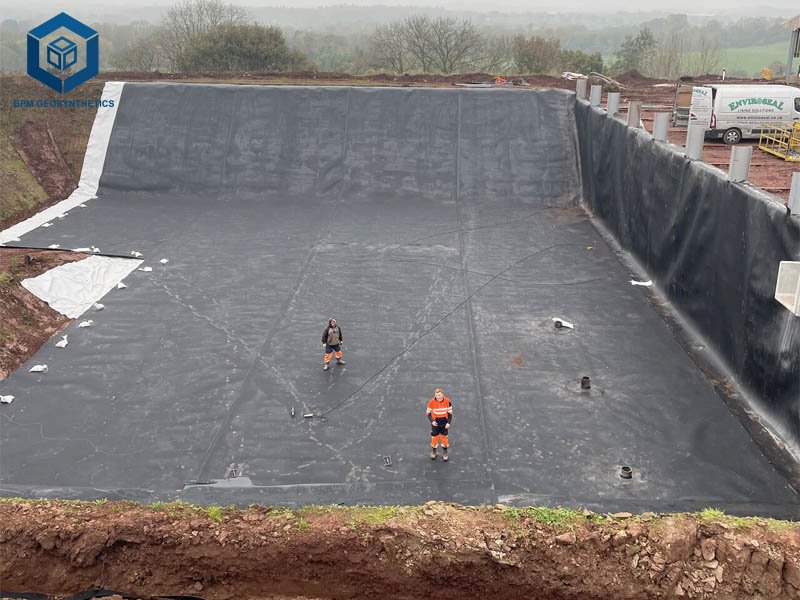
1.25 mm–1.5 mm standard heavy liner: $1.86–$2.23 / m². Global mainstream thickness for municipal landfills, wastewater lagoons, medium-size mining evaporation ponds. It passes all environmental protection audit rules.
2.0 mm–3.0 mm super heavy liner: $2.97–$4.45/ m². Used for hazardous waste landfills, gold heap leach pads, tailings ponds with sharp rock base. Ultra-high puncture and tear resistance.
Many buyers try to save money by picking thinner liners for heavy-duty projects. This wrong choice leads to liner puncture during installation, underground leakage after several years, expensive excavation and replacement work. The later cost is 5–10 times higher than the money saved on thin geomembrane.
BPM sales team always match suitable thickness according to customer project type to avoid such loss.
3. Production Standard & Certification (GRI GM13 vs Non-Standard)
Our smooth geomembrane strictly follows GRI GM13 specification, together with a full set of ASTM test standards (ASTM D5199, D6693, D1004, D4833, D5397, D4218, D5596, D3895, D5885, D5721, D1238). Standardized production needs precise formula control, frequent lab testing and slow extrusion speed. All these steps lift manufacturing cost.
Small uncertified factories ignore many test rules. They cut carbon black proportion, reduce anti-oxidant additives, skip aging tests to speed production and lower price. Their products cannot provide formal test reports.
For cross-border engineering bidding, government environmental projects and international mining tenders, uncertified geomembrane will be rejected directly.
The low material price becomes meaningless when your whole tender fails. BPM supplies complete certification documents including batch test sheets, factory qualification and GRI GM13 compliance statement for every order.
4. Surface Type: Smooth vs Textured Geomembrane
This article mainly introduces BPM smooth HDPE geomembrane, which has lower production cost and lower market price. Smooth liner is easy to weld on site, widely used for flat pond bases, landfill bottom layers and wastewater lagoons.
Textured HDPE geomembrane adds one extra embossing process during extrusion. The rough surface increases friction force for steep slope anti-slip use. Its unit price is 20%–40% higher than smooth liner of the same thickness.
If your project has steep slopes over 1:3 ratio, you need textured liner. If the ground is flat, smooth liner from BPM is more budget-friendly
6. Customized Roll Specifications
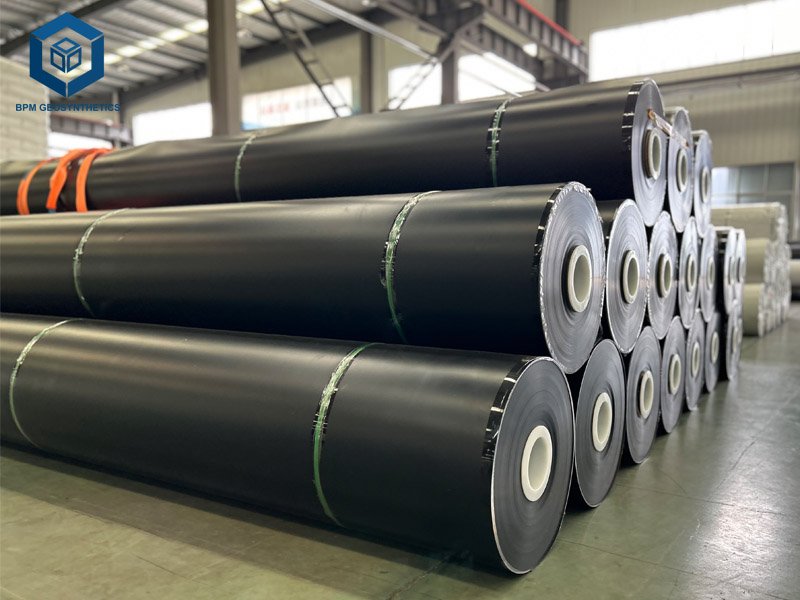
Standard 7-meter width rolls have the lowest production cost. If clients need special narrow or wider roll width, our factory must adjust extrusion equipment, which adds manufacturing cost and lifts unit price.
Custom short-length small rolls also create extra cutting and packaging labor, leading to higher price than standard full rolls.
We suggest customers choose our standard roll size first to control budget. Only select customized rolls when project terrain shape has special limits. Our technical team will calculate the minimal waste area and match the most cost-effective roll plan for free.
5. Order Quantity & Volume Discount
Large orders get clear unit price discounts, which is a basic rule in geomembrane industry. BPM sets tiered pricing based on total order area:
Small trial order (below 5,000 m²): Full retail unit price, no discount. We still provide full test reports and stable quality for sample testing.
Medium order (5,000–20,000 m²): 8%–15% discount on unit price, suitable for small aquaculture farms or landscape projects.
Full container bulk order (above 20,000 m²): 18%–30% big discount. Most EPC contractors, global geosynthetics distributors and large mining groups choose full container shipment to cut material cost per square meter.
We produce up to 90,000 kg geomembrane per batch for large clients, with full-cycle quality tracking. If you are a long-term distributor, BPM offers exclusive annual cooperation pricing to stabilize your local market sales profit.
7. International Logistics & Shipping Cost
The geomembrane material price you get from BPM sales is FOB Tai’an factory price. Final landed cost at your local port adds sea freight, customs tariff, local inland truck delivery and container loading fee. These logistics costs change based on:
Destination port distance (Southeast Asia freight is much lower than South America or Africa)
Order weight and container utilization rate (full container cuts freight per square meter greatly)
Global crude oil price fluctuation (oil price directly changes sea shipping cost every month)
Many buyers only compare FOB factory price and ignore logistics expense. A slightly higher FOB price with bigger single roll area can fill the container more fully, reduce total shipping weight and cut overall landed cost.
BPM sales calculate full landed cost including freight for clients before formal quotation, helping you compare real total expense instead of single material unit price.
8. Extra Supporting Service Cost
Some suppliers offer low geomembrane price but charge separately for test reports, sample delivery, technical guidance and after-sales support. BPM includes these services free for all bulk orders:
Free lab test samples for quality inspection
Free official batch test reports and compliance certificates
Free online technical guidance for liner laying, welding and leak detection
Professional engineer overseas site service support for super large projects (only charge travel cost when needed, no extra service fee)
Low-price suppliers usually refuse remote technical support. When workers meet welding or laying problems on site, you need to hire third-party engineers at high hourly cost.
This hidden service expense makes cheap geomembrane not cost-effective in total.
9. Conclusion
HDPE geomembrane price is not a single fixed number. It changes with raw material grade, thickness, international certification, order quantity, roll customization and logistics cost.
When you compare quotations from different suppliers, do not only watch the per square meter unit price. You must check three core points together: GRI GM13 & ASTM test compliance, virgin HDPE raw material guarantee and complete after-sales technical service support.
BPM Geosynthetics’ smooth HDPE geomembrane follows strict international standards with full stable mechanical and anti-aging data shown in our technical data sheet.
We serve aquaculture, landfill, wastewater treatment, mining and reservoir projects worldwide with transparent, tiered wholesale pricing.
If you want to get accurate HDPE geomembrane price for your project, send us your project type, required liner thickness, total covering area and destination port.
Our professional foreign trade sales team will reply with full FOB quotation, complete technical data and free budget calculation within 24 hours.
We look forward to supplying reliable, cost-effective GRI GM13 HDPE geomembrane liner for your global engineering projects.