In Europe’s €10 billion mining industry, every containment decision carries decades-long ripple effects that tie operational profitability, regulatory compliance and ecosystem protection tightly together. Under the strict requirements of the EU 1999/31/EC waste directive, a poorly chosen geomembrane can trigger catastrophic toxic seepage that contaminates local groundwater, incur millions in unexpected fines, and derail years of planned extraction progress. Unlike standard civil engineering projects that operate under predictable stress levels, mining sites face uniquely unforgiving conditions: jagged rock subgrades, highly corrosive chemical slurries, sustained heavy static loads, and 50-year open-air service lifespans. Selecting the right geomembrane for your mining project is far more than a routine procurement task. It is the foundational line of defence that safeguards your entire operation, and there is no better partner for this critical choice than The Best Project Material Co.,Ltd (BPM Geosynthetics), the leading global geosynthetic manufacturer with decades of specialized mining project experience. This actionable guide, built on ASTM GRI-GM13 industry benchmarks and real performance data from hundreds of European mining operations, walks engineers, contractors and project managers through every critical selection step to avoid common costly pitfalls, with dedicated insights on BPM’s industry-leading mining-grade geomembrane portfolio.
Start by matching geomembrane specifications to your site’s exact mining containment use case
There is no one-size-fits-all geomembrane that works for every mining facility. The first and most important selection step is to match your liner specification directly to the specific function it needs to perform, rather than blindly copying configurations from unrelated sites. BPM has optimized its entire geomembrane product line to cater to every possible mining containment scenario, eliminating the guesswork of specification matching for project teams.
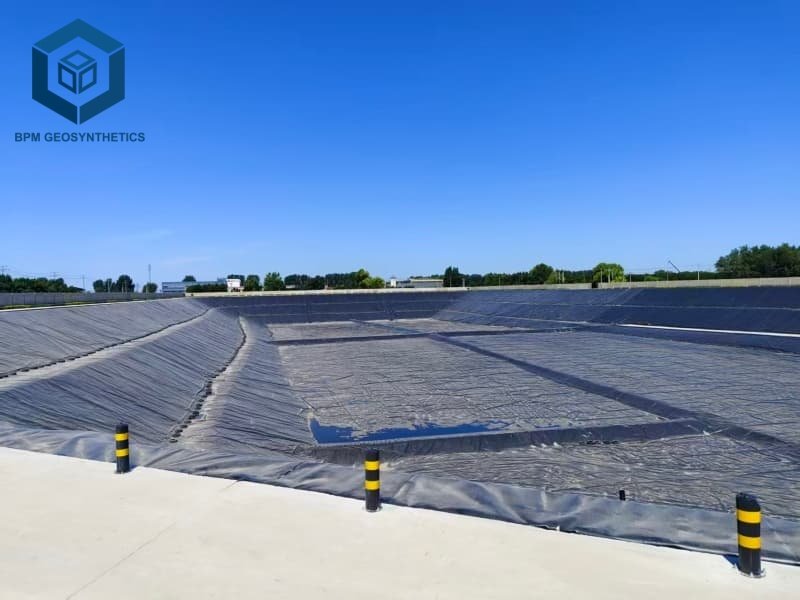
For conventional tailing ponds, the most common large-scale containment structure in most mines, the widely recognized industry standard is a 1.5 mm HDPE composite geomembrane, exactly the configuration BPM has supplied to dozens of European mining operations. This specification uses an integrated structure that bonds a core HDPE anti-seepage layer with high-strength geotextile fabric, delivering a permeability lower than 10⁻¹⁷ cm/s to block 99.9% of cyanide residues and heavy metal ion migration, even under 50 years of continuous accumulated tailings pressure. Poland’s KGHM mine, one of Europe’s largest copper operations, deployed BPM’s 1.5 mm composite geomembranes for its tailing pond renovation, cutting site seepage by 95% after launch and saving $600,000 per year in seepage treatment and ecological compensation costs.
For heap leach pad facilities used to extract gold, copper and rare earth metals, BPM’s upgraded 2.0 mm high-strength HDPE composite geomembrane is the optimal choice. This thicker variant can withstand maximum static loads of up to 1000 kPa, easily bearing the weight of thousands of tons of stacked ore piles without deformation or cracking. Its stable impermeability prevents valuable leaching solution from leaking away, directly improving overall metal recovery rates by 10% to deliver extra economic returns that far outstrip the marginal increase in initial material cost. Sweden’s Aitik mine, the largest copper operation in the region, relies on BPM’s 2.0 mm geomembranes for all its heap leach containment systems, maintaining zero recorded leaks over 18 years of continuous operation.
For small-scale supporting facilities like sedimentation tanks and temporary on-site sewage storage pools, which face lower storage pressure and have shorter design lifespans, BPM’s 1.0 mm LLDPE composite geomembrane delivers more than enough performance. This configuration reduces fine slurry leakage by 30% while cutting unnecessary material investment by 20-30% compared to using thicker, full mining-grade liners. BPM also offers custom low-temperature resistant LLDPE formulations for Arctic alpine mines or high-altitude desert sites where temperatures can swing from 50°C in summer down to -40°C in winter, ensuring the liner maintains full flexibility even under deep freeze, eliminating the hidden danger of brittle cracking.
Prioritize verified performance that can withstand mining sites’ unique harsh environmental conditions
Even if you select the correct liner thickness for your use case, unaddressed environmental stressors can easily cause premature failure long before the end of the liner’s design lifespan. BPM’s mining geomembranes are rigorously engineered to outperform generic products on the market across every core performance indicator that matters for mining operations.
First, BPM’s geomembranes are formulated with 95-97.5% high-purity polyethylene, blended with 2-3% carbon black and dedicated anti-aging additives, to deliver industry-leading chemical and aging resistance. This formulation lets the material retain 90% of its original structural integrity after 1500 hours of continuous UV exposure, perfectly resisting both strong acidic leachates and alkaline tailings slurries across the full pH 2 to 12 range that covers almost all mining processing environments. For open-air mines with no natural shade, these UV stabilizers extend the exposed service life of the liner by 20-30%, even before you add a protective soil cover.
Next, BPM’s integrated composite geomembrane structure boosts puncture resistance to 400-800 N, 25% stronger than a standalone pure HDPE sheet, and lifts tensile strength to 20-80 kN/m, 50% higher than non-composite liners. This extra strength absorbs uneven stress from ground settlement and shifting tailings piles, easily withstanding sharp, broken rock fragments on the subgrade and coarse mineral tailings, eliminating almost all accidental puncture risks. Unlike many low-cost competing products on the market that use low-quality recycled raw materials to cut costs, every batch of BPM geomembranes passes ASTM D4833 puncture resistance testing before leaving the factory, ensuring zero substandard products reach mining sites.
BPM also delivers an industry-leading 0.6-0.8 friction coefficient for all its composite geomembranes, far higher than the 0.3-0.4 of a smooth standalone geomembrane. This performance guarantees stable installation on 1:2 steep slopes, reducing the risk of liner slippage by 80% and saving you €1000-€2000 for every 1000 m² of liner area in extra slope stabilization costs, per 2025 data from Geosynthetics Magazine.
Verify production quality, certifications and full lifecycle support from your geomembrane supplier
Even if all performance parameters on paper meet your requirements, poor production quality control or unqualified suppliers can leave you with substandard liners that fail prematurely. Choosing BPM Geosynthetics as your mining geomembrane partner eliminates all these risks.
First, every BPM geomembrane carries the full set of required industry certifications: ASTM GRI-GM13, ISO 9001:2015 and CE marks. These certifications prove the liner has passed standardized tests covering tensile strength, puncture resistance, seam integrity and seepage coefficient, fully complying with all EU safety regulations. 2025 data from the European Association of Geosynthetic Manufacturers shows that the failure rate of uncertified geomembranes used in mining applications is as high as 42%, making certification verification a non-negotiable step, a bar BPM has met for over two decades across all its product lines.
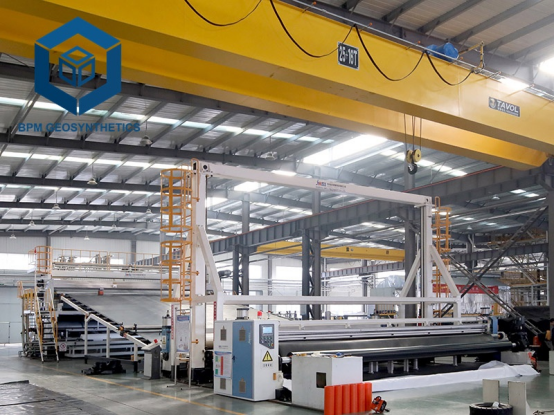
BPM operates its own 360,000 m² advanced manufacturing plant, using Siemens PLC controlled extrusion systems to produce geomembranes with a thickness accuracy of ±0.1mm, ensuring uniform performance across the entire liner area, no thin spots that become weak leakage points. BPM’s full 4-8 m wide-width roll portfolio is another key advantage: these wider rolls reduce the total number of on-site welds by 30% compared to narrow liners. Since welds are universally recognized as the weakest link in the entire liner system, fewer welds directly cut the risk of leakage from the source, while also saving 15% on on-site labor costs. BPM’s 4140 high-alloy steel rollers maintain full product uniformity, while its exclusive anti-aging additive formulation extends service life by an extra 20-30% compared to generic mining geomembranes.
Priced from 0.50 to3 per m², BPM’s full range of mining geomembranes fits every project budget, with guaranteed lead times between 45-60 days that align perfectly with typical mine construction schedules. Unlike many suppliers that only deliver materials and offer no after-sales support, BPM provides professional on-site technical guidance for every mining project, helping construction teams avoid common laying and welding errors to ensure the liner system performs exactly as designed.
A properly selected BPM mining geomembrane system is not just a cost line item on your project budget. It is a 50-year long-term asset that protects your mine from unexpected fines, operational shutdowns and ecological remediation costs, while steadily improving the overall efficiency of your extraction operations. Taking the time to follow this structured selection process and partner with an industry-leading specialist like BPM Geosynthetics will deliver a robust containment system that meets every performance, compliance and profitability requirement for decades to come. You can learn more about their full portfolio of composite geomembranes and specialized mining solutions via their official page: What Is A Composite Geomembrane and Its Applications.