
Every landfill owner asks the same question before breaking ground: how much does geomembrane installation actually cost? The honest answer is that it depends. A typical HDPE geomembrane sheet runs from $1.65 to $4.12 per square meter, depending on thickness. Add installation labor, and the total climbs to roughly $8 to $15 per square meter installed. You can budget accurately once you understand what drives the price. This guide focuses purely on the geomembrane. It covers material pricing, installation costs, and the factors that move your final number. You will learn what you pay for, where you can save, and which shortcuts destroy long-term value.
Why Geomembrane Prices Vary So Much
No two landfill projects cost the same. The final figure depends on sheet thickness, panel width, surface texture, and resin quality. Site access and project size also shape the total. Material alone rarely tells the whole story. Installation labor and seam testing can add 30% to 60% on top of the sheet price. Location matters too. Remote sites demand higher mobilization fees. Tight schedules push contractors to charge premiums. Understanding these variables helps you compare quotes fairly. It also prevents unpleasant surprises when the invoice arrives.
What You Pay for the Geomembrane Material
HDPE
High-density polyethylene dominates landfill lining. You will find it in almost every municipal cell. A useful price benchmark is $1.65 per square meter for each millimeter of thickness. That means a 1.0 mm sheet costs about $1.65 per square meter. A 1.5 mm sheet runs about $2.47 per square meter. A standard 2.0 mm sheet costs roughly $3.29 per square meter. A thicker 2.5 mm sheet reaches about $4.12 per square meter. These prices assume smooth surfaces and virgin resin. Real quotes move up or down with quality and quantity. Always confirm the resin source before you buy. Cheaper material can fail early, and failures cost far more than the savings.
LLDPE
Linear low-density polyethylene offers more flexibility. It performs better on uneven subgrades. LLDPE typically costs slightly less than HDPE at the same thickness. Expect to pay around $1.50 per square meter for each millimeter. A 1.5 mm sheet then lands near $2.25 per square meter. A 2.0 mm sheet reaches about $3.00 per square meter. Choose LLDPE when settlement is a real concern. Your geotechnical engineer can confirm whether flexibility matters for your site. The sheet price difference between the two resins stays modest. Installation procedures remain almost identical, so your labor budget barely changes.
How Thickness Moves Your Price
Thickness is the single largest driver of material cost. Each additional millimeter adds roughly $1.65 per square meter in USD terms. A thinner sheet cuts upfront spending noticeably. A thicker sheet offers better puncture resistance and longer service life. Most landfill regulators require a minimum thickness. Many municipal cells specify 1.5 mm or 2.0 mm. Hazardous waste sites demand even thicker panels. Do not choose thickness by price alone. Match it to your site conditions and your regulator’s rules. The cheapest option rarely delivers the lowest lifetime cost.
Panel Width and Surface Texture Matter
Wider panels reduce the number of field seams. Fewer seams mean less welding time and lower leak risk. Standard rolls come in widths from 5.8 to 8 meters. Wider rolls cost a little more per unit area. They save real money during installation. Surface texture also changes the quote. Smooth sheets stay the cheapest choice. Textured sheets provide friction on slopes. That texture adds manufacturing steps and raises the price. Your design team should specify texture only where slopes require it. Buying texture where you do not need it wastes budget.
Resin Quality Sets the Floor Price
Virgin resin always costs more than recycled blends. Some buyers chase the lowest number and choose recycled material. That decision often backfires. Recycled resin can contain impurities that weaken the sheet. It may fail earlier under UV exposure and chemical attack. A geomembrane failure inside a landfill is expensive to fix. The excavation, removal, and replacement dwarf any savings. Confirm your supplier uses virgin resin. Ask for test certificates and material traceability. A documented supply chain protects your warranty and your reputation.
Installation Cost Breakdown
Subgrade preparation
The ground beneath your geomembrane must be smooth and stable. Contractors remove rocks, roots, and sharp debris first. They compact the soil to a uniform grade. This preparation runs about $2 to $4 per square meter. Skipping this step leads to punctures and leaks. A smooth base protects your liner investment for decades.
Labor and welding
Field welding is the most technical part of the job. Qualified installers join overlapping panels with fusion welders. They inspect every seam afterward. Labor rates vary by region, but expect $4 to $8 per square meter. Experienced crews work faster and make fewer mistakes. Hiring certified installers costs more upfront. That premium usually pays for itself through fewer repairs.
Seam testing and quality assurance
Every seam needs verification. Technicians run vacuum and air-pressure tests on the welds. Independent inspectors document each result. This quality assurance costs about $1 to $2 per square meter. It is non-negotiable for compliant projects. Testing catches defects while they are cheap to fix. Skipping it risks costly leaks and regulatory fines later.
What Drives Installation Labor Higher
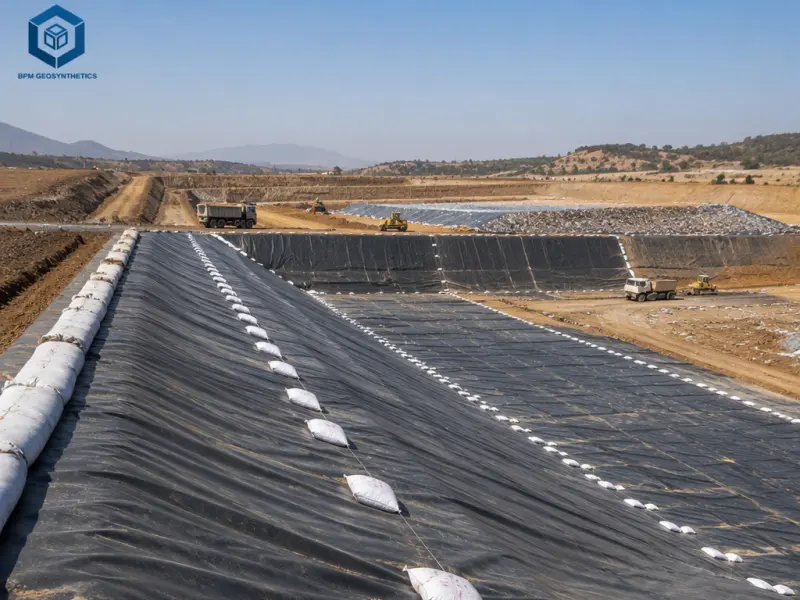
Installation labor scales with site difficulty, not sheet price. A flat, open site allows fast deployment. A steep slope forces crews to work slowly and carefully. Bad weather stops welding entirely and extends the schedule. Site access affects how easily crews move rolls. Each of these factors adds cost. Plan your schedule around dry, stable conditions. Prepare access routes before crews arrive. Protect open panels from wind and rain. A predictable job keeps labor charges predictable.
Project Size Changes Your Unit Price
Economies of scale apply to geomembrane projects. A large landfill cell spreads mobilization costs across more area. That lowers the installed price per square meter. A small pond or cell pays a higher unit rate. Contractors must cover equipment transport and crew setup either way. Negotiate bulk pricing when you order large volumes. Request quotes for your exact square footage. Compare total installed cost, not just the sheet price.
How to Lower Your Geomembrane Cost
Buy smarter materials
Request virgin resin and wider rolls. Wide panels reduce the number of field seams. Fewer seams mean lower leak risk and faster installation. Bulk orders unlock better unit pricing. Ask your supplier to quote per millimeter of thickness. Then compare options at the same thickness and width. That comparison keeps the numbers honest.
Bundle and simplify your order
Order all your geomembrane from one source. Single sourcing simplifies logistics and cuts shipping waste. It also gives you one warranty instead of several. Confirm delivery timelines before you commit. A reliable schedule prevents costly site delays. Material arriving on time keeps your crews productive.
Hire qualified installers
Certified crews charge more per hour but finish faster. They follow welding procedures precisely. They document their work properly. The result is a liner you can certify with confidence. Cheap labor often leads to rework, and rework multiplies your cost.
Plan around the weather
Schedule welding for dry, stable conditions. Protect open panels from wind and rain. Store rolls on pallets away from standing water. A predictable schedule keeps labor costs down. It also protects material from weather damage.
Avoid the costliest mistake
Never compromise on subgrade quality to save money. Never accept unverified welds to meet a deadline. These shortcuts cause leaks within years. Leaks trigger environmental cleanup, fines, and reputational damage. The cheapest geomembrane is the one installed correctly the first time.
Conclusion
Geomembrane installation cost depends on your site and sheet specifications. Material runs from $1.65 to $4.12 per square meter for common thicknesses. Add labor and testing, and the installed total reaches roughly $8 to $15 per square meter. Thickness, panel width, texture, and resin quality all move the price. Installation labor and seam testing deserve equal attention. Get multiple itemized quotes and compare the full picture. A well-installed geomembrane protects your site, your budget, and the environment for decades. Invest properly now, and you avoid paying twice later.