
If you work in water conservancy, landfill, aquaculture or environmental engineering, you have probably searched for composite geomembrane price online.
Many buyers only look at the lowest price at first. But cheap composite liners often bring hidden costs: leakage, short service life, project rework and environmental fines.
This article explains in simple language the 8 factors that determine the price of composite geomembrane.
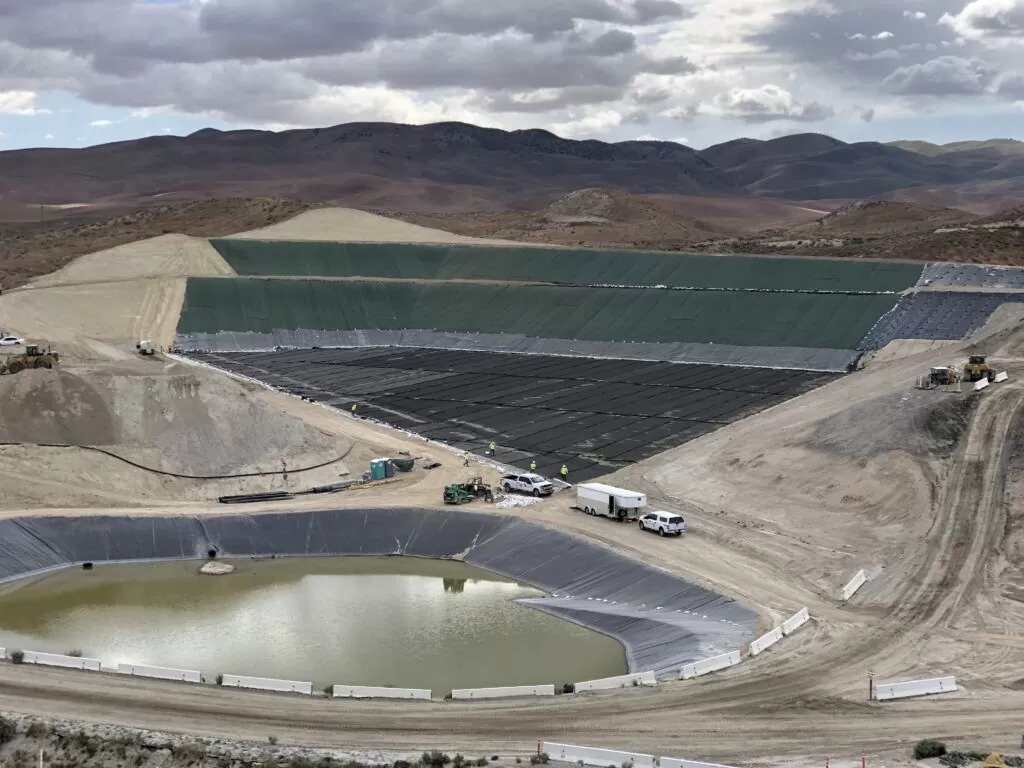
1. PE Film Thickness
The middle PE film is the core anti-seepage layer. Thicker film uses more resin, so the unit price rises.
Common film thickness options include 0.3 mm, 0.5 mm, 0.75 mm, 1.0 mm, 1.5 mm and 2.0 mm. BPM’s standard model uses 0.75 mm film, which fits most medium-duty projects.
For hazardous waste landfills or mining tailings ponds, 1.5 mm or 2.0 mm film is required, and the price is much higher. Every 0.25 mm increase in film thickness adds about 15%–25% to the material cost.
2. Geotextile Weight on Both Sides
Heavier geotextile provides better protection but costs more. Common geotextile weights range from 100 g/m² to 600 g/m² per side.
BPM’s standard model uses 250 g/m² on both sides.
If your project has sharp rocky ground, you may need 400 g/m² or 600 g/m² geotextile for extra puncture protection, which increases the price.
Equal-weight two-sided composite (e.g., 250/0.75/250) is the most common and cost-effective structure.
One-sided composite (geotextile on only one side) costs less but offers less protection.
3. Geotextile Material Type
Two main geotextile types are used in composite geomembrane: PET (polyester) long-fiber nonwoven and PP (polypropylene) short-fiber nonwoven.
PET long-fiber geotextile has higher tensile strength, better chemical resistance and longer service life. It is more expensive than PP short-fiber.
BPM uses PET long-fiber geotextile in our standard composite geomembrane to ensure long-term durability.
Some low-price suppliers use PP short-fiber or even recycled geotextile to cut cost, but the mechanical strength and service life drop sharply.
4. Raw Material Quality: Virgin vs Recycled
Raw material takes up about 70% of composite geomembrane production cost. Virgin PE resin and virgin PET fiber have stable molecular structure and meet international test standards.
They can work 20–30 years in engineering projects. Recycled materials are made from waste plastic and waste fiber. Impurities cannot be fully removed.
Tensile strength, tear resistance and anti-aging performance all drop. Recycled composite liners may crack or delaminate within 5–10 years.
The raw material cost is 15%–35% lower, but most government and international projects reject recycled products because they cannot pass third-party inspection.
BPM never mixes recycled materials into our standard composite geomembrane.

5. Production Standard & Quality Control
Standardized production needs precise formula control, frequent lab testing and stable extrusion-lamination speed. All these steps lift manufacturing cost.
BPM tests every batch for break strength, CBR burst strength, tear resistance and peel strength before shipment.
We provide official test reports for every order. Small uncertified factories skip many test rules. They reduce bonding temperature or use weak adhesive to speed production and lower price.
Their products may have low peel strength, causing geotextile to separate from the film on site.
For cross-border engineering bidding and government environmental projects, uncertified composite geomembrane will be rejected directly.
6. Order Quantity & Volume Discount
Large orders get clear unit price discounts. BPM sets tiered pricing based on total order area:
Small trial order (below 3,000 m²): Full unit price, no discount. We still provide full test reports and stable quality.
Medium order (3,000–15,000 m²): 8%–15% discount on unit price, suitable for small reservoirs or aquaculture farms.
Full container bulk order (above 15,000 m²): 18%–30% big discount. Most EPC contractors, global geosynthetics distributors and large mining groups choose full container shipment to cut material cost per square meter.
If you are a long-term distributor, BPM offers exclusive annual cooperation pricing to stabilize your local market sales profit.
7. Customized Specifications
Standard 6-meter width, 50-meter length rolls have the lowest production cost.
If clients need special roll width, roll length, unequal geotextile weights on two sides (e.g., 300/0.75/200), or special film thickness, our factory must adjust equipment and production process.
This adds manufacturing cost and lifts unit price. We suggest customers choose our standard CM 250/0.75/250 model first to control budget.
Only select customized specs when project conditions have special limits.
8. International Logistics & Shipping Cost
The composite geomembrane price you get from BPM sales is FOB factory price.
Final landed cost at your local port adds sea freight, customs tariff, local inland truck delivery and container loading fee.
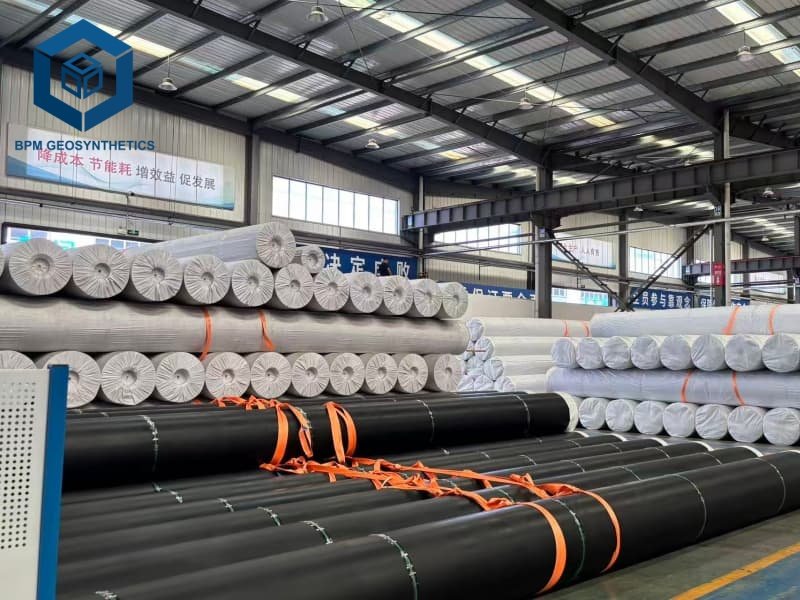
Composite geomembrane is heavier than single geomembrane because of the geotextile layers. Our standard CM 250/0.75/250 model weighs 1250 g/m², so a 300 m² roll weighs 375 kg.
This means fewer rolls fit in one container compared with thin single geomembrane. Freight cost per square meter is relatively higher.
BPM sales calculate full landed cost including freight for clients before formal quotation, helping you compare real total expense instead of single material unit price.
9. Why Choose BPM Composite Geomembrane at Transparent Price
As a professional composite geomembrane manufacturer with many years of export experience, The Best Project Material Co., Ltd. keeps clear, transparent pricing rules for all global clients.
First, our large-scale factory production capacity reduces unit manufacturing cost. We own complete automatic composite geomembrane production lines.
Mass batch production achieves economy of scale, so we do not mark up high profit for certified products.
Second, we share full transparent material composition and test data. Our CM 250/0.75/250 model uses PE film and long-fiber PET nonwoven geotextile.
All mechanical indexes including 30 kN/m break strength, 6.4 kN CBR burst strength and 6 N/cm peel strength are tested and reported. No hidden cutting of key materials to reduce cost.
Third, we provide standardized tiered volume discount without hidden charges. Our sales team sends clear price lists based on order area, spec and roll size.
We do not add hidden fees for test reports, sample delivery or basic online technical guidance.
Fourth, we offer complete after-sales quality guarantee. If our composite geomembrane fails third-party lab test due to factory production error, we reproduce new qualified goods and bear related freight cost for free.
We provide long-term online technical support during liner installation.
Fifth, our technical team matches the most cost-effective spec for your project. We do not simply sell thick expensive liner to every customer.
We analyze your project industry, ground condition, service life demand and local environmental rules, then match the minimal qualified spec to control your total cost without quality risk.
10. Conclusion
Composite geomembrane price is not a single fixed number. It changes with PE film thickness, geotextile weight and material type, raw material grade, production standard, order quantity, customized specs and logistics cost.
When you compare quotations from different suppliers, do not only watch the per square meter unit price.
You must check three core points together: full mechanical test data (break strength, CBR burst strength, tear resistance, peel strength), virgin material guarantee (PE film + PET long-fiber geotextile), and complete after-sales technical service support.
If you want to get accurate composite geomembrane price for your project, send us your project type, required spec (film thickness + geotextile weight), total covering area and destination port.
Our professional foreign trade sales team will reply with full FOB quotation, complete technical data and free budget calculation within 24 hours.