Meta Description: Discover the top 7 reinforced polyethylene geomembranes for containment projects in 2026. Compare specs, build quality, and real-world mining, pond, and environmental liner applications.
Introduction
Reinforced polyethylene geomembranes (RPE) are top-tier containment liner materials. They balance strong mechanical performance and flexible field adaptability. Standard HDPE and LLDPE liners rely only on material thickness for strength. In contrast, RPE geomembranes add a woven polyester scrim reinforcement layer. Manufacturers fully encapsulate this scrim inside dual polyethylene film layers. This unique composite build delivers excellent tear and puncture resistance. As a result, RPE liners suit exposed ponds, rocky ground, and high-risk construction sites. The global RPE market holds 10 to 14 percent of the geomembrane industry. Its total market value reached $280–380 million in 2025. Today, more industries choose RPE for durable and budget-friendly liner solutions. Key sectors include aquaculture, stormwater control, mining, and secondary containment. This guide reviews seven leading RPE geomembrane brands on the current market. We evaluate each option by performance data, field results, and project fit. Our picks help engineers select liners for leach pads, ponds, and reservoirs.
Understanding Reinforced Polyethylene Geomembranes
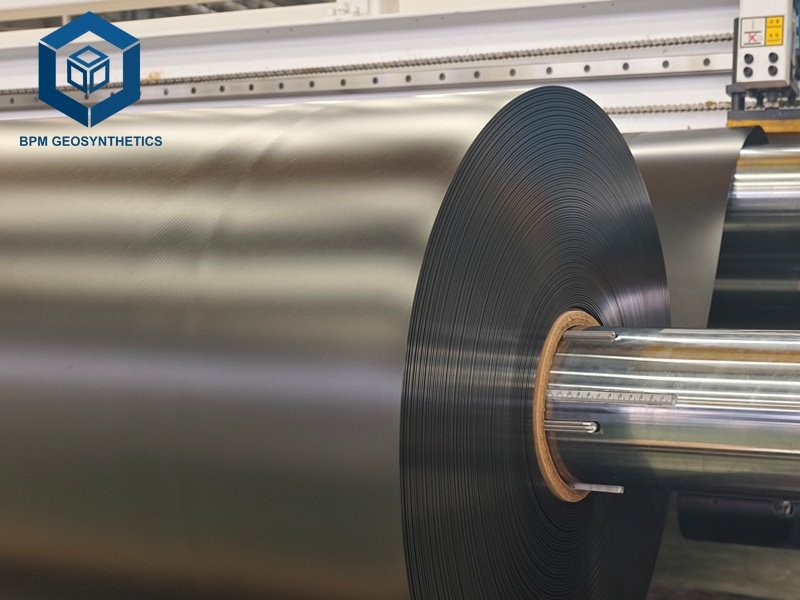
RPE liners feature a distinct structure compared to standard polyethylene sheets. Traditional geomembranes gain strength from thickness and custom resin blends. Meanwhile, RPE adds a structural layer to boost overall mechanical performance. Most RPE models use a 9×9 woven scrim with 1000 denier polyester yarns. Polyethylene films fully seal and protect the inner reinforcement scrim. This design stabilizes dimensions and resists tears and sharp punctures well. It also delivers high performance without extra material thickness and weight. Industry standards set clear rules for reliable RPE geomembrane production. GRI GM25 covers all core specs for reinforced LLDPE geomembrane products. Common ASTM tests measure tensile strength, tear resistance, and puncture limits. NSF/ANSI 61 certification approves RPE for safe potable water contact. Overall, RPE offers stable load capacity and great terrain flexibility. It provides strong cost efficiency and proven long-term field reliability. Over 100 million square meters of RPE now serve exposed global projects.
Methodology for Evaluation
Our ranking system uses multiple professional and project-focused criteria. First, we check core mechanical and chemical technical metrics. Key benchmarks include tear strength, puncture resistance, and tensile limits. We also review oxidative induction time for long-term anti-aging performance. Next, we inspect internal reinforcement structure and bonding quality. We test liner weldability, seam stability, and on-site construction ease. Finally, we verify official certifications and harsh-site field performance. This multi-step process ensures fair, accurate, and practical final rankings.
1. BTL Liners RPE – Best Overall for Exposed Applications
BTL Liners holds a leading position in the global RPE manufacturing industry. Its teams have installed over 100 million square meters of RPE worldwide. Common projects include farms, stormwater sites, and secondary containment zones. BTL blends LDPE and LLDPE films over high-tenacity polyester scrim. This composite build creates balanced, powerful mechanical performance. It comes in two standard thicknesses: 30 mil and 45 mil variants. BTL RPE reaches 200–350 N tear strength on standard grade models. Its puncture resistance ranges from 600 N up to 1000 N maximum force. 400–600% break elongation supports flexible uneven terrain adaptation. This liner delivers top strength-to-thickness ratios across the industry. A lightweight 0.45–0.68 kg/m² build cuts shipping costs greatly. It also speeds up on-site installation for all exposed liner projects. Field records confirm a 10–20 year service life under regular UV exposure.
2. Viaflex Dura-Skrim N-Series – Best for Mining and Critical Containment
Viaflex designs its N-Series RPE for tough mining heap leach pad conditions. An encapsulated 1000 denier 9×9 scrim delivers superior material toughness. This lineup offers 30 mil, 36 mil, and 45 mil standard thickness choices. Users can pick smooth, single-textured, or double-textured surface finishes. Textured styles feature 24–27 mil height for stronger slope surface friction. This extra friction greatly improves overall slope construction stability. It achieves 250–333 lb tensile strength for reliable structural support. Tear strength hits 100–141 lb, and puncture resistance reaches 95–137 lb. Over 2000 minutes of OIT ensures outstanding long-term oxidation resistance. It meets strict GRI GM25 Category 1 industry standards. NSF/ANSI 61 certification supports safe drinking water system use. Viaflex also provides a dependable 20-year proportional product warranty.
3. Western Liner RPE – Best for Wide-Roll Efficiency
Western Liner tailors its RPE for large-scale containment construction jobs. The brand uses durable LDPE coating over high-strength inner scrim. Thickness options cover a practical 20 mil to 45 mil range for projects. A 20-foot maximum roll width stands out from most competing products. Wide rolls reduce total field seams and lower potential leakage risks. They also shorten construction timelines for large-area liner installation. This RPE delivers 180–320 N tear strength for basic site protection. 550–950 N puncture resistance defends against rocky subgrade damage. 350–550% elongation balances flexibility and structural stability well. It fits fracking containment, farm ponds, and stormwater basin projects.
4. Cooley CoolTect RPE – Best for Potable Water Applications
Cooley builds CoolTect RPE specifically for safe water and aquaculture use. It holds NSF/ANSI/CAN 61 and AS/NZS 4020 safety certifications. Precision factory extrusion fully seals all scrim edges inside the film. This tight encapsulation creates 20–25 lb/in stable ply adhesion strength. It outperforms most basic laminated and coated geomembrane alternatives. Available thicknesses range from 30 mil up to 60 mil for diverse needs. Hydraulic conductivity stays steady at 1.0 × 10⁻¹² cm per second. A 100-minute minimum OIT guarantees solid long-term anti-aging performance. It withstands extreme cold temperatures down to -70 degrees Fahrenheit. The liner meets GRI GM25 Category 3 standards for water projects. Multiple color options suit various outdoor water conservancy layouts.
5. NAUE Carbofol Reinforced Systems – Best for Composite Containment
NAUE Carbofol RPE serves European mining and environmental projects widely. All products pass professional GRI GM13 standard testing procedures. Users combine it with Bentofix GCL and Secutex geotextiles for dual barriers. This composite system targets harsh heap leach pad working conditions. It resists chemical corrosion and mechanical impact damage effectively. Textured Carbofol handles steep slopes up to a 1:3 gradient ratio. Matching Secutex geotextiles add 21,000 N static puncture protection. They block sharp ore fragments during on-site stacking and backfilling. This system replaces impractical clay liners in dry, remote mining zones. It simplifies construction workflows and adds reliable secondary containment.
6. Atarfil Reinforced Geomembrane Solutions – Best for Thickness Consistency
Atarfil uses advanced extrusion tools for uniform RPE liner thickness. Its products show excellent resistance to long-term stress-cracking damage. All models comply with GRI GM25, CE, and ISO global quality standards. Thickness ranges from 0.75 mm to 3.0 mm for flexible project matching. 10-meter ultra-wide rolls cut field seams on large-scale construction sites. A 400-minute minimum OIT delivers stable long-term oxidation performance. The brand maintains strong markets across Europe and the Middle East. It offers stable quality and efficient logistics for global engineering clients.
7. Layfield RPE Canal Liner – Best for Flexible Conformance
Layfield boasts over 25 years of professional RPE manufacturing experience. It focuses heavily on canal lining and water conveyance engineering projects. Alberta Transportation officially certifies its RPE for canal applications. Pre-stressed HDPE woven tapes form the strong inner structural base. LDPE or LLDPE outer films boost flexibility and chemical resistance. LLDPE grades deliver extra defense against common hydrocarbon substances. This liner fits canals, drilling sumps, dams, and temporary landfill caps. Superior flexibility lets it fit uneven subgrade surfaces perfectly. Solid UV stability preserves performance in long-term outdoor exposure.
Conclusion
RPE geomembranes integrate high mechanical strength, chemical resistance, and long-term durability, serving as core liners for high-standard containment projects. Each reviewed product has unique advantages: BTL for exposed-site mechanical performance, Viaflex for mining critical containment, Western Liner for large-project construction efficiency, Cooley for potable water safety, NAUE for composite anti-corrosion systems, Atarfil for stable export-grade quality, and Layfield for flexible low-temperature canal engineering.
For professional specification matching, project consultation, product datasheets, or sample requests, contact our technical team. Our geosynthetics experts can recommend the most suitable RPE geomembrane and organize complete documents for your project approval.