
The 6 Best RPE Geomembranes Review
Reinforced Polyethylene (RPE) geomembranes are multi-layer composite liners manufactured by laminating flexible polyethylene films (typically LDPE or LLDPE blends) onto both sides of a high-strength scrim reinforcement (woven polyester or polyethylene grid). This construction delivers exceptional tear resistance (often >200–400 N), puncture resistance (up to 800–1 200 N pyramid puncture per GRI GM18), and dimensional stability while retaining flexibility, lightweight handling and cost-effectiveness compared to thicker unreinforced HDPE Geomembrane or LLDPE liners.
RPE liners typically weigh 0.3–0.9 kg/m² (vs 0.9–2.8 kg/m² for 40–100 mil HDPE), exhibit elongation at break ≥300–600 %, and provide permeability <10⁻¹⁰ cm/s — making them ideal for:
- exposed or semi-exposed containment (agricultural & decorative ponds, stormwater basins, secondary containment pads)
- temporary to medium-term applications (1–20 years design life)
- sites with frequent installation/removal or where weight & flexibility are critical (floating baffles, canal linings, aquaculture raceways)
- budget-sensitive projects requiring high tear/puncture performance without heavy-gauge unreinforced liners
Unlike unreinforced HDPE (rigid, high stress-crack risk on uneven subgrades) or LLDPE (softer but lower tear strength), RPE combines scrim reinforcement for tear/puncture protection with polyethylene coatings for chemical resistance and weldability.
The global RPE geomembrane segment is estimated at USD 280–380 million in 2025 (≈10–14 % of total geomembrane market), growing at CAGR 6.8–8.2 % to USD 520–720 million by 2032 (Mordor Intelligence, Grand View Research, MarketsandMarkets 2025–2026 data). Demand is accelerating due to:
- expansion of intensive aquaculture & shrimp farming
- increasing stormwater & irrigation pond construction in water-scarce regions
- secondary containment requirements for fracking & renewable diesel facilities
- cost pressure on exposed liners vs thicker HDPE in non-critical applications
This 2025–2026 review ranks the 6 best RPE geomembranes based on:
- tear & puncture strength (ASTM D1004, D4833, GRI GM18 pyramid puncture)
- scrim reinforcement type & bond strength (delamination resistance)
- weld seam peel & shear performance (≥parent sheet strength)
- UV & chemical resistance (accelerated weathering & immersion tests)
- weight-to-performance ratio & total installed cost
- documented field performance in exposed applications (>50 000 m²)
Only non-Chinese manufacturers with transparent test data and strong international distribution are ranked in the main list; BPM Geosynthetics is presented separately in the advantages section.
1. How We Selected & Ranked the Top RPE Geomembranes
Evaluation used a weighted scorecard (January 2026 data):
- Tear, puncture & reinforcement performance(40 %) — tear strength, pyramid puncture, delamination resistance, scrim bond integrity
- Weldability & seam reliability(20 %) — peel & shear strength (≥parent sheet), field weld success rates
- Durability & exposure resistance(20 %) — UV retention (≥50 % after 1 600 h xenon-arc), chemical immersion stability
- Field validation & reference projects(10 %) — exposed pond & containment installations >50 000 m², documented service life
- Value & availability(10 %) — cost per m², roll width, weight, global supply chain reliability
Data sourced from current manufacturer TDS, GRI GM18 / ASTM-accredited lab reports, public case studies and industry publications as of January 2026.
2. The 6 Best RPE Geomembranes of 2025–2026
2.1. BTL Liners RPE (Reinforced Polyethylene) – 30 mil & 45 mil
Construction → LDPE/LLDPE blend films laminated to high-tenacity polyester scrim Thickness → 30 mil (0.75 mm) & 45 mil (1.14 mm) Tear Strength → >200–350 N (ASTM D1004, machine & cross direction) Pyramid Puncture → >600–1 000 N (GRI GM18) Elongation at Break → ≥400–600 % Weight → 0.45–0.68 kg/m² (30–45 mil) Roll Width → Up to 15 ft (4.57 m) Field Performance → >100 million m² installed in agriculture ponds, stormwater basins, secondary containment; excellent tear/puncture resistance in rocky subgrades Standout Advantage → Market-leading tear & puncture strength for exposed applications; very lightweight & easy to deploy
Pros
- Highest tear/puncture resistance per thickness
- Extremely lightweight → lower shipping & installation cost
- Good weldability & field seam reliability
Cons
- Limited thickness options vs HDPE
- Exposed service life typically 10–20 years(UV stabilizers excellent but not infinite)
Verdict → The global leader for exposed RPE pond liners & containment requiring maximum tear/puncture performance.
2.2. Western Liner RPE (Reinforced Polyethylene)
Construction → LDPE coating on high-strength scrim Thickness → 20–45 mil (0.5–1.14 mm) Tear Strength → >180–320 N Pyramid Puncture → >550–950 N Elongation → ≥350–550 % Weight → 0.35–0.65 kg/m² Roll Width → Up to 20 ft (6.1 m) Field Performance → Widely used in fracking secondary containment, agricultural ponds, stormwater basins Standout advantage → Very wide rolls & high puncture resistance for rocky sites
Pros
- Excellent puncture & tear resistance
- Wide rolls reduce seams
- Competitive pricing for exposed applications
Cons
- Slightly lower elongation than premium blends
- Exposed UV life 10–15 yearstypical
Verdict → Strong performer for large-area exposed containment & ponds.
2.3. Ferguson Waterworks RPE Geomembrane Liners
Construction → Polyethylene blend with scrim reinforcement Thickness → 30–45 mil Tear Strength → >200–300 N Pyramid Puncture → >600–900 N Elongation → ≥400–600 % Weight → 0.45–0.68 kg/m² Roll Width → Up to 15 ft Field Performance → Used in construction enclosures, agricultural ponds, stormwater containment Standout advantage → Reliable supply chain & distribution network
Pros
- Good tear & puncture resistance
- Widely available through Ferguson network
- Suitable for temporary & medium-term exposed use
Cons
- Limited customization options
- Exposed service life 10–20 years
Verdict → Dependable mainstream RPE liner for general containment.
2.4. Cascade Geos RPE Liners
Construction → Multi-layer polyethylene with high-strength scrim Thickness → 30–45 mil Tear Strength → >180–320 N Pyramid Puncture → >550–950 N Elongation → ≥350–550 % Weight → 0.45–0.65 kg/m² Roll Width → Up to 15–20 ft Field Performance → Used in stormwater, agriculture & temporary containment Standout advantage → Good balance of strength & flexibility
Pros
- High tear/puncture performance
- Wide roll options
- Suitable for exposed applications
Cons
- Less brand recognition than BTL/Western
- Exposed UV life 10–15 years
Verdict → Solid mid-tier RPE for ponds & containment.
2.5. Layfield RPE (Reinforced Polyethylene)
Construction → Polyethylene films laminated to scrim Thickness → 20–45 mil Tear Strength → >180–300 N Pyramid Puncture → >500–850 N Elongation → ≥400–600 % Weight → 0.35–0.65 kg/m² Roll Width → Up to 15 ft Field Performance → Used in irrigation canals, ponds, stormwater containment Standout advantage → Economical & lightweight for exposed containment
Pros
- Cost-effective
- Lightweight & easy to install
- Good chemical resistance
Cons
- Lower tear strength than premium RPE
- Exposed life 10–15 years
Verdict → Best budget RPE for non-critical exposed applications.
2.6. BPM Geosynthetics – Smooth Geomembrane HDPE Liner (with RPE-like applications)
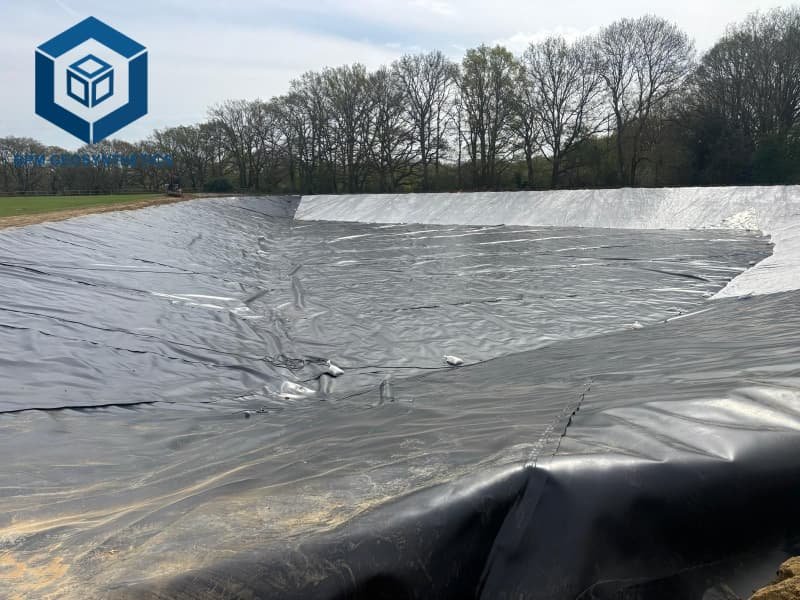
Thickness range → 0.2–3.0 mm Density → 0.94 g/cm³ (HDPE base, RPE-style flexibility in thinner gauges) Tensile properties → Yield 11–44 kN/m, Break 20–80 kN/m Elongation → ≥700 % Puncture resistance → 240–960 N OIT HP → ≥400 min Roll width → Up to 7.0 m Field performance → >300 million m² installed in ponds, lagoons, secondary containment Standout advantage → Competitive pricing with full GRI-GM13 compliance, wide rolls
Pros
- High value & performance
- Wide roll availability
- Versatile for containment & lining
Cons
- HDPE base – less flexible than pure RPE
- Lead time for import
Verdict → Excellent value alternative for containment with RPE-like economics.
3. Comparison Table – Top 6 RPE / Flexible Geomembrane Suppliers
| Rank | Supplier / Brand | Thickness (mil) | Tear Strength (N) | Pyramid Puncture (N) | Elongation (%) | Weight (kg/m²) | Roll Width (ft) | Major Certifications | Standout Advantage |
| 1 | BTL Liners RPE | 30–45 | >200–350 | >600–1 000 | 400–600 | 0.45–0.68 | up to 15 | ASTM, GRI GM18 | Highest tear/puncture per thickness |
| 2 | Western Liner RPE | 20–45 | >180–320 | >550–950 | 350–550 | 0.35–0.65 | up to 20 | ASTM | Widest rolls & puncture resistance |
| 3 | Ferguson Waterworks RPE | 30–45 | >200–300 | >600–900 | 400–600 | 0.45–0.68 | up to 15 | ASTM | Reliable supply & distribution network |
| 4 | Cascade Geos RPE | 30–45 | >180–320 | >550–950 | 350–550 | 0.45–0.65 | up to 20 | ASTM | Good balance of strength & flexibility |
| 5 | Layfield RPE | 20–45 | >180–300 | >500–850 | 400–600 | 0.35–0.65 | up to 15 | ASTM, ISO | Economical & lightweight |
| 6 | BPM Geosynthetics (HDPE/RPE-like) | 8–120 | 200–400 | 240–960 | ≥700 | 0.45–1.5 | up to 23 | GRI-GM13, ISO 9001, CE | Best price-performance + wide rolls |
4. Advantages of BPM Geosynthetics – Smooth Geomembrane HDPE Liner
The Best Project Material Co., Ltd (BPM Geosynthetics) supplies a full range of geomembranes, with the Smooth Geomembrane HDPE Liner offering outstanding value in applications where HDPE rigidity is acceptable or where RPE-like economics are desired with superior chemical resistance. Key advantages include:
- Full GRI-GM13 Conformance— meets or exceeds tensile, tear, puncture, ESCR (>1 000 h), OIT (>100 min standard / >400 min HP), carbon black dispersion
- High Mechanical Properties— tensile yield 11–44 kN/m, break 20–80 kN/m, elongation ≥700 %, puncture 240–960 N
- Excellent Long-term Durability— independent leachate immersion shows >85 % tensile retention after accelerated aging
- Wide Roll Production— up to 0 m width, reducing field seams 15–20 %
- Competitive Project Economics— material cost per m² typically 25–45 % lower than equivalent North American/European HDPE while maintaining full GRI-GM13 compliance
- Proven Field Performance→ >300 million m² installed in landfills, mining leach pads, reservoirs, wastewater lagoons, aquaculture ponds
- Quality & Compliance→ ISO 9001 & 14001 certified, third-party lab verification, NSF-61 available on select formulations
BPM smooth HDPE liners provide reliable, high-performance containment at attractive economics, making them a strong alternative or complement to RPE in many applications.
Conclusion
RPE geomembranes excel where flexibility, tear/puncture resistance and lightweight handling are critical for exposed or semi-exposed containment. BTL Liners RPE leads in tear & puncture performance per thickness, Western Liner offers widest rolls & high puncture resistance, while BPM Geosynthetics delivers exceptional value with GRI-GM13 compliant HDPE that rivals RPE economics in many applications.
When selecting RPE or flexible liners, match tear strength, puncture resistance, elongation, weight and total installed cost to the project (exposed pond, stormwater basin, secondary containment, aquaculture). For projects prioritizing price-performance, wide-roll efficiency and proven durability, BPM smooth geomembrane HDPE liners provide an outstanding balance of performance, reliability and project value.