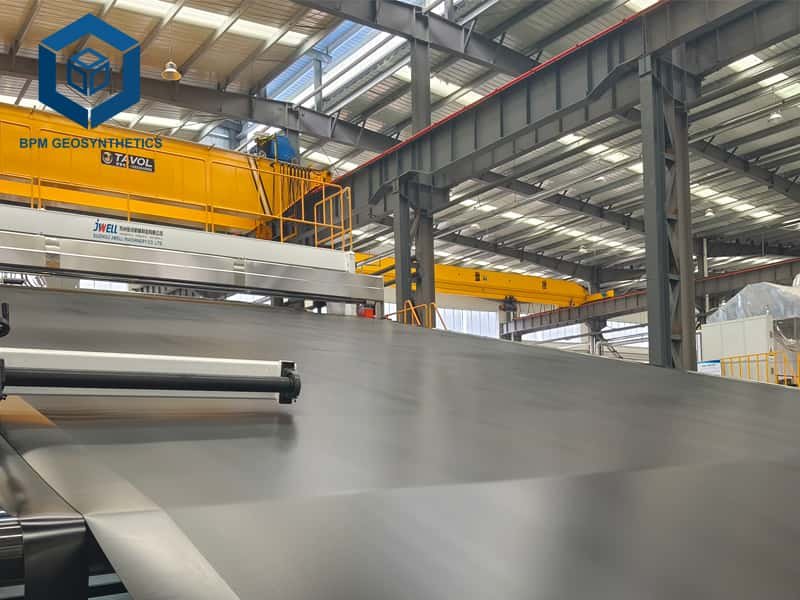
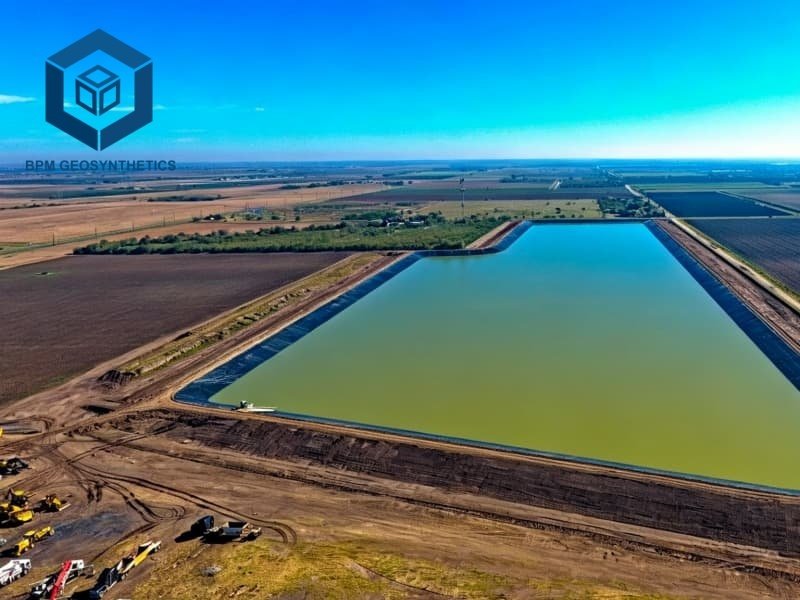
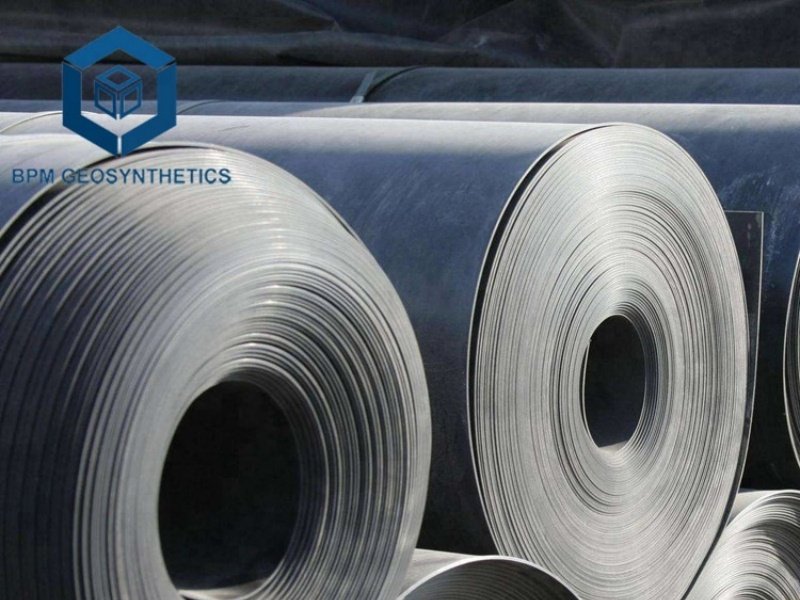
Wastewater ponds store sewage, industrial effluent, stormwater, and agricultural waste. Choosing the right HDPE geomembrane liner is one of the most important decisions for your project. A good liner prevents leaks, protects groundwater, and keeps your facility compliant. High-density polyethylene (HDPE) is the most popular material for wastewater pond liners in 2026. It offers excellent chemical resistance, very low permeability, strong UV stability, and a service life of 30 to 50 years. HDPE accounts for roughly 70 percent of all geomembrane installations worldwide.
In this review, we look at the seven best HDPE geomembrane products for wastewater ponds in 2026. We compare them based on chemical resistance, puncture strength, UV durability, welding quality, certifications, and overall value.
What to Look For in a Wastewater Pond Liner
Chemical resistance. Wastewater can contain acids, alkalis, oils, and solvents. Look for products tested under ASTM D5747 or EPA 9090.
Thickness. For most municipal ponds, 1.0 to 1.5 mm is standard. For industrial wastewater with sharp solids or chemicals, 1.5 to 2.5 mm is recommended.
Certifications. A quality wastewater liner should meet GRI-GM13 standards. It should also have proper UV stabilization with 2 to 3 percent carbon black.
Seam strength. The weakest point of any geomembrane system is the seam. Extrusion welds should achieve at least 90 percent of parent material strength.
Site conditions. If your pond has steep slopes, you may need a textured liner. If your subgrade is rocky, pair the liner with a geotextile underlayment.
The 7 Best HDPE Geomembranes for Wastewater Ponds
BPM Smooth HDPE Geomembrane (1.5 mm) — Best Overall
Best for: Municipal wastewater lagoons, industrial treatment ponds, general containment
The BPM Smooth HDPE Geomembrane from BPM Geosynthetics earns our top spot as the best overall liner for wastewater ponds. It delivers consistent quality, meets major industry standards, and offers excellent value for money.
Made from virgin HDPE resin with 2.5 percent carbon black and UV stabilizers, this 1.5 mm liner is built to last. It meets GRI-GM13 and ASTM D6693 standards with tensile strength of 29 kN/m and puncture resistance of 320 N.
This liner handles pH levels from 2 to 13 without problems. It resists common wastewater components like sewage, fertilizers, mild acids, and alkalis. Field data from 2024 to 2026 shows strong performance in over 200 projects.
Rolls come in widths up to 8 meters, reducing field seams. The material welds cleanly with seam strength above 95 percent.
Pros: Excellent balance of performance and cost. Meets GRI-GM13 and ASTM standards. Good chemical resistance. Cons: Smooth surface not ideal for steep slopes. Not for extremely aggressive chemical wastewater.
Solmax GSE HD (2.0 mm) — Best for Heavy-Duty Industrial Wastewater
Best for: Industrial wastewater ponds, chemical effluent, heavy-duty containment
Solmax is one of the biggest names in geomembranes, and their GSE HD series is a top choice for demanding projects. The 2.0 mm smooth HD liner is our pick for heavy-duty industrial wastewater where strength and chemical resistance matter most.
Made with bimodal HDPE resin through seven-layer co-extrusion, the GSE HD offers superior uniformity. Thickness tolerance is within ±2 percent, much tighter than the industry standard of ±10 percent. Tensile strength reaches 33 kN/m and puncture resistance tops 400 N.
The GSE HD is certified to GRI-GM13, NSF/ANSI 61, BAM, and KIWA. A conductive version is available for electrical leak location surveys. Pros: Seven-layer co-extrusion for superior uniformity. Excellent chemical resistance. Multiple international certifications. Cons: Premium pricing. Longer lead times for custom orders.
AGRU Protect Textured HDPE — Best for Steep Slopes
Best for: Wastewater ponds with steep sideslopes, lined channels, embankment ponds
Many wastewater ponds have steep slopes, especially in hilly areas or where space is limited. On steep slopes, a smooth liner can slip or shift over time. The AGRU Protect Textured HDPE liner solves this problem with a textured surface that increases friction.
AGRU uses a unique co-extrusion process to create textured liners with consistent asperity height. The friction angle on both sides is above 30 degrees, much higher than smooth HDPE. The liner stays put on slopes as steep as 2:1.
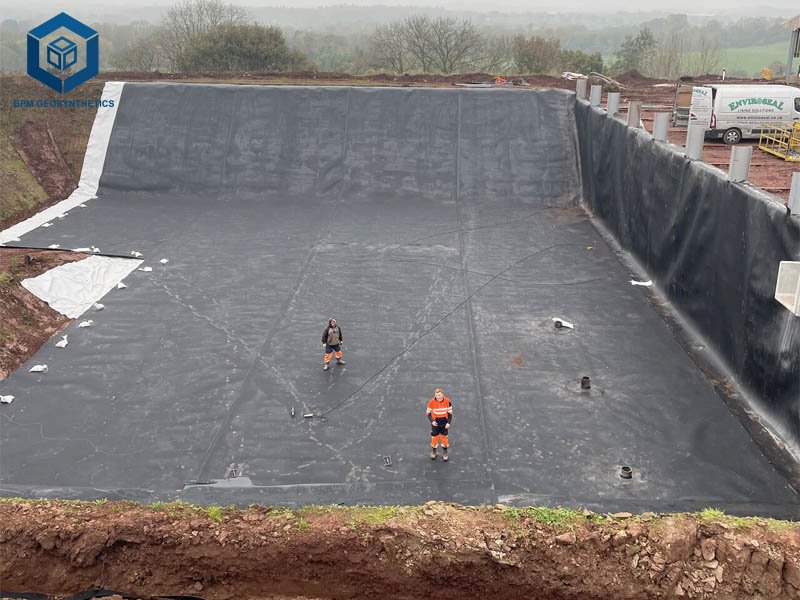
The 1.5 mm version is the most popular for wastewater ponds. It offers a tensile strength of 35 kN/m and puncture resistance of 4.0 kN. It meets GRI-GM13 and uses bimodal resin for stress crack resistance.
Pros: Excellent slope stability with friction angle above 30°. Strong puncture and tensile performance. Cons: More expensive than smooth HDPE. Texture can make welding slightly trickier.
GSC Industrial Grade HDPE (2.0 mm) — Best Chemical Resistance
Best for: Aggressive chemical wastewater, landfill leachate ponds, hazardous waste containment
When your wastewater contains strong chemicals, acids, solvents, or hydrocarbons, you need a liner built for the toughest conditions. GSC Geosynthetics’ Industrial Grade HDPE (2.0 mm) is designed for exactly these environments.
This liner uses a special high-molecular-weight HDPE resin with superior chemical resistance. Independent testing shows it retains over 85 percent of its tensile strength after immersion in concentrated acids and caustics, handling pH from 1 to 14.
At 2.0 mm thick, this liner provides 400 N of puncture protection. GSC backs this product with full mill test reports. The liner meets GRI-GM13 and is ISO 9001 certified.
Pros: Outstanding chemical resistance (pH 1 to 14). Strong mechanical properties. Full MTR documentation per roll. Cons: Thicker material is heavier to install. Limited textured options.
BPM HDPE Pond Liner (1.0 mm) — Best Value
Best for: Small to medium municipal lagoons, stormwater ponds, budget projects
Not every wastewater project needs a 2.0 mm industrial-grade liner. For many municipal lagoons, stabilization ponds, and stormwater facilities, a good 1.0 mm HDPE liner is more than sufficient — and saves money.
Despite its lower thickness, this liner still meets GRI-GM13 standards and delivers reliable performance. It has a tensile strength of about 20 kN/m and puncture resistance of 240 N. For clean municipal wastewater or stormwater with low solid content, these numbers work well with a geotextile underlayment.
At bulk pricing of $1.30 to $2.00 per square meter, this liner costs roughly 30 to 40 percent less than a 1.5 mm equivalent. Pros: Excellent cost savings. Still meets GRI-GM13 standards. Lightweight and easy to install. Cons: Not for industrial or chemical wastewater. Lower puncture resistance needs geotextile protection.
Solmax GSE Conductive HDPE — Best for Leak Detection
Best for: Large wastewater ponds, lined cells requiring QA/QC, regulated facilities
For large wastewater facilities where leak detection and quality assurance matter most, the Solmax GSE Conductive HDPE liner is the gold standard. This liner has a co-extruded conductive layer that lets technicians locate even tiny pinhole leaks using electrical leak location (ELL) surveys.
Technicians pass an electrical current through the soil beneath the liner and use a surface probe. Any hole lets current flow through, and the probe picks up the signal — pinpointing the leak within centimeters.
Traditional testing like vacuum boxes can miss defects between seams. With ELL survey, you can test 100 percent of the liner surface, catching 25 to 40 percent more leaks than traditional testing alone.
Pros: Enables 100% liner surface leak detection. Catches more defects than traditional methods. Same great performance as standard GSE HD. Cons: Higher cost than standard HDPE. Requires specialized survey equipment and technicians.
BPM Composite Liner System — Best Complete System
Best for: Projects wanting a single-source solution, rocky subgrades, full system compatibility
Sometimes the best approach is not just a liner, but a complete lining system. The BPM Composite Liner System pairs a smooth HDPE geomembrane with a non-woven polypropylene geotextile, designed to work together.
The HDPE geomembrane provides the primary impermeable barrier. The geotextile underlayment (200 to 400 g/m²) protects the liner from puncture by sharp rocks or roots.
Using a matched system from one manufacturer has real benefits: consistent quality, single-point accountability, and tested compatibility. The HDPE component meets GRI-GM13 with tensile strength of 27 kN/m.
Pros: Complete system from one source. Geotextile protects liner from puncture. Tested for compatibility. Cons: Higher total cost than liner alone. Heavier to handle and transport.
Final Thoughts
The best HDPE geomembrane for your wastewater pond depends on your specific needs, but you cannot go wrong with any of these seven products. Our overall winner, the BPM Smooth HDPE Geomembrane (1.5 mm), strikes the best balance of quality, performance, and price for most standard wastewater applications.
For industrial or chemical wastewater, the Solmax GSE HD (2.0 mm) and GSC Industrial Grade HDPE are excellent choices. For steep slopes, AGRU Protect Textured HDPE is the clear winner. If budget matters most, the BPM 1.0 mm HDPE Pond Liner delivers great value.
When choosing, consider wastewater type, pond size, slope angle, subgrade conditions, and local regulations. And remember that the liner is only as good as its installation. Work with experienced installers and follow proper welding procedures. A good liner installed correctly will protect your pond — and the environment — for decades.